Key Takeaways
- There is no single CMD command that downloads and updates every driver. Any guide promising one magic line is wrong. Microsoft splits driver servicing across three tools—pnputil, DISM, and PowerShell’s PSWindowsUpdate—and this article shows exactly when to use each.
- pnputil is the real bulk-install command for a running PC.
pnputil /add-driver *.inf /subdirs /installinstalls every driver package in a folder at once. It’s built into Windows and works on Windows 11 and 10. - PowerShell’s PSWindowsUpdate is the closest thing to “update all drivers from the internet.” It pulls Microsoft-approved driver updates from Windows Update via the command line—the only command-line route that actually downloads.
Quick answer: To update drivers using CMD, open Command Prompt as administrator. To install drivers from a folder, run
pnputil /add-driver "C:\Drivers\*.inf" /subdirs /install. To download Microsoft-approved driver updates, use PowerShell: install the PSWindowsUpdate module, then runInstall-WindowsUpdate -MicrosoftUpdate. There is no single native command that updates every driver at once.
Introduction
You want to skip the clunky driver-updater apps and just do it from the command line. Smart instinct—but here’s the honest truth most guides bury: there is no one-line cmd command that scans your PC, downloads the latest versions, and installs them all at once. Microsoft simply doesn’t build driver servicing that way.
That doesn’t mean the command line is useless — far from it. Once you know the right tools, you can update drivers using CMD safely and completely.
I’ve used these exact commands to rebuild drivers on dozens of fresh Windows installs, and in this guide I’ll show you the three that genuinely work: pnputil for installing driver packages, DISM for offline images, and PowerShell for pulling updates straight from Windows Update.
For a broader look at every way to update drivers—including the software and Device Manager methods—see our main guide on how to update all drivers at once.
You’ll learn how to use the command prompt for driver management the right way, which command fits your situation, and—just as important—what CMD honestly can’t do. Home users and office users can follow every step.
The Honest Truth: Why There’s No Single “Update All Drivers” Command
Let me clear up the myth first, because it saves you hours of frustration. Windows delivers drivers through several separate channels — Windows Update for most hardware, and vendor installers for GPU, chipset, and specialty devices. No single built-in command bridges all of them.
So when you search for a command to update all drivers, what you’re really after is a small toolkit:
- pnputil—installs INF-based driver packages you already have on disk.
- DISM — adds drivers to a Windows image (mainly offline).
- PowerShell + PSWindowsUpdate — downloads Microsoft-approved driver updates from the internet.
Used together, these bring nearly every driver up to date from the command line. Used alone, each does one specific job. Below, I’ll show all three so you can pick the appropriate command for updating drivers in the command line for your situation.
How to Use Command Prompt for Driver Management (First Steps)
Before any work on driver updates using the command prompt, do two things:
Open an elevated prompt. Press the Start button, type cmd, right-click Command Prompt, and choose Run as administrator. Every command here needs admin rights — without them, they silently fail.
See what’s installed. To list every third-party driver already on your system, run:
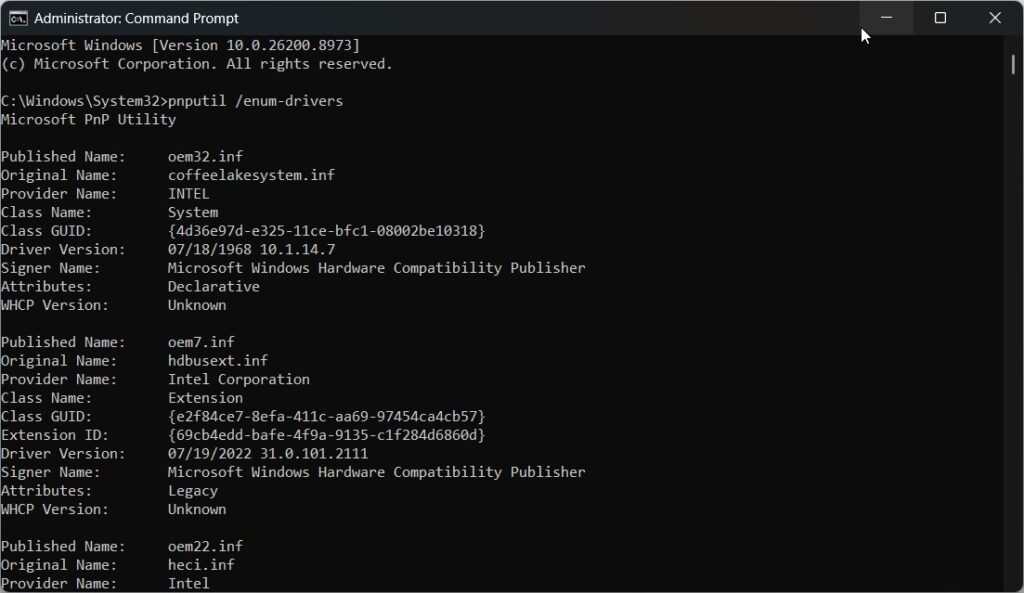
pnputil /enum-driversThis shows each driver’s published name, original INF, version, and date—a useful inventory before you change anything. To trigger Windows to recheck hardware and match any pending drivers, run the following:
pnputil /scan-devicesThat’s the foundation. Now, the three methods to actually update drivers are –
Method 1: pnputil—The Real Bulk-Install Command
This is the pnputil command for updating drivers, and it’s the one that genuinely installs many drivers at once on a live, running PC. It’s built into every copy of Windows 11 and 10, so there’s nothing to download.
The scenario: you’ve downloaded driver packages (or backed them up) into a folder, and you want to install them all. First, extract them—pnputil needs the actual .inf files, not the original setup .exe. Then run:
pnputil /add-driver "C:\Drivers\*.inf" /subdirs /installHere’s what each part does, straight from Microsoft’s documentation:
/add-driver "C:\Drivers\*.inf"— targets every INF file in the folder./subdirs— traverses subfolders too, so nested driver packages are caught./install— actually installs/updates the driver on any matching device (without this flag, it only adds them to the store).
This single line is how you update all drivers through cmd when you have the packages on hand—after a clean Windows install, a motherboard swap, or restoring a driver backup.
One honest limitation: pnputil only installs drivers you already have as files, and only if the driver is the highest-ranked match for the device. It won’t force an older or mismatched driver onto hardware. If you see “No driver packages found,” your folder path is wrong or holds installers rather than extracted INF files.
Method 2: DISM — For Offline Images and Deployment
DISM is powerful, but there’s a crucial distinction most guides get wrong: DISM driver management targets offline Windows images, not your live running system. Use it when preparing a Windows image for deployment or servicing a mounted install.
To list drivers in an online image:
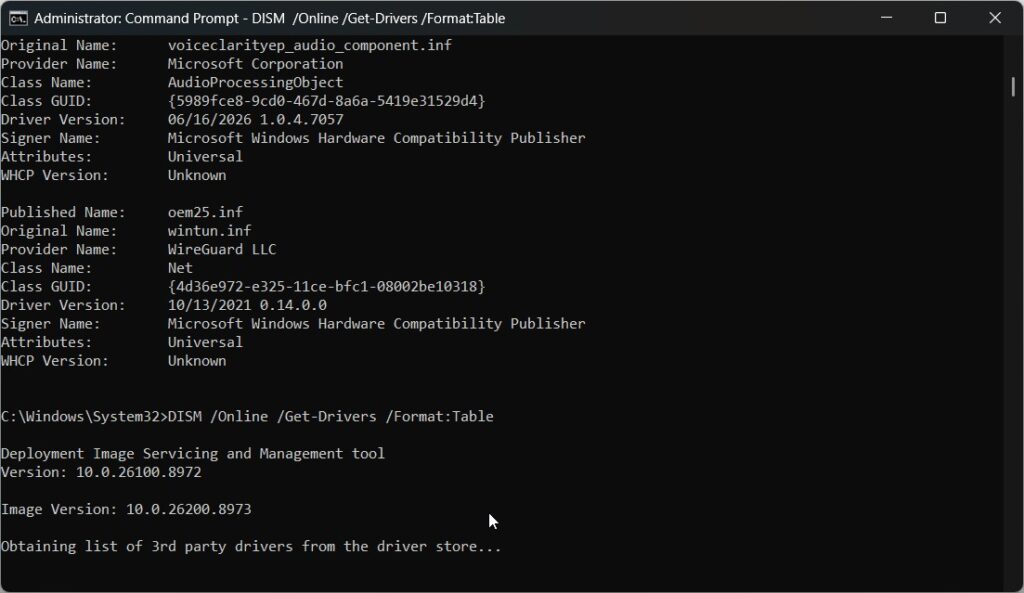
DISM /Online /Get-Drivers /Format:TableTo add all driver packages from a folder to an offline image, including subfolders:
DISM /Image:C:\mount\offline /Add-Driver /Driver:C:\Drivers /RecurseThe /Recurse flag pulls in every subfolder’s packages. Microsoft’s own caution: it /Recurse can bloat an image, since shared payload files get duplicated per INF—so point it at a clean driver folder, not your whole Downloads directory.
For a normally running PC, use pnputil (Method 1) instead—that’s the right tool for a live system. DISM is the deployment specialist.
Method 3: PowerShell + PSWindowsUpdate — Download From Windows Update
This method is the closest thing to what people imagine when they search “update all drivers cmd automatically“—a command that actually reaches out to the internet and pulls driver updates. It uses PowerShell (technically a shell, but a command line all the same) and a free, widely trusted module.
Step 1 — Install the module. Open PowerShell as an administrator and run:
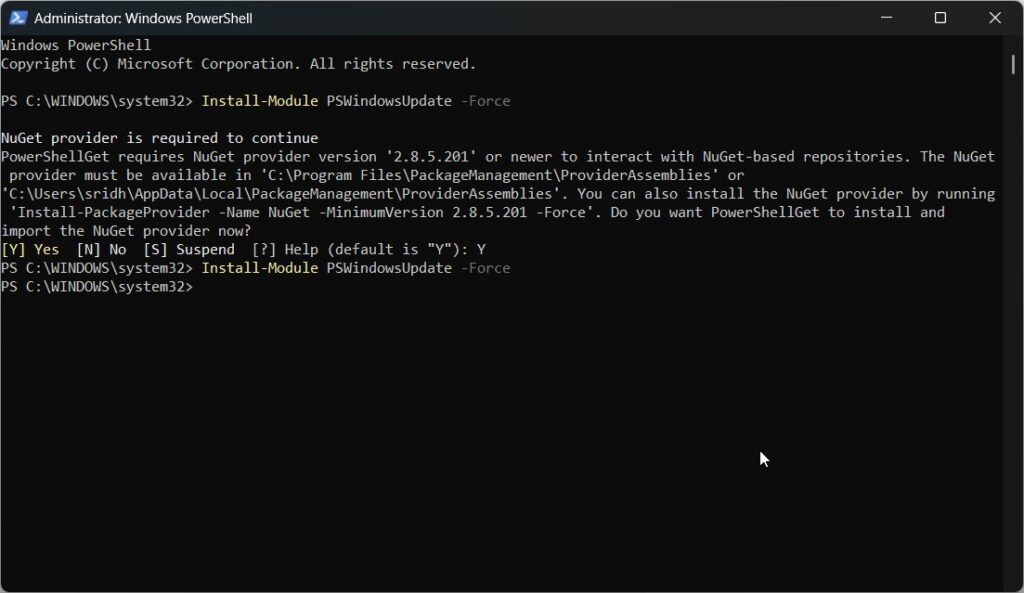
Install-Module PSWindowsUpdate -ForceIf it’s blocked, set the execution policy first: Set-ExecutionPolicy RemoteSigned -Scope CurrentUser, then retry.
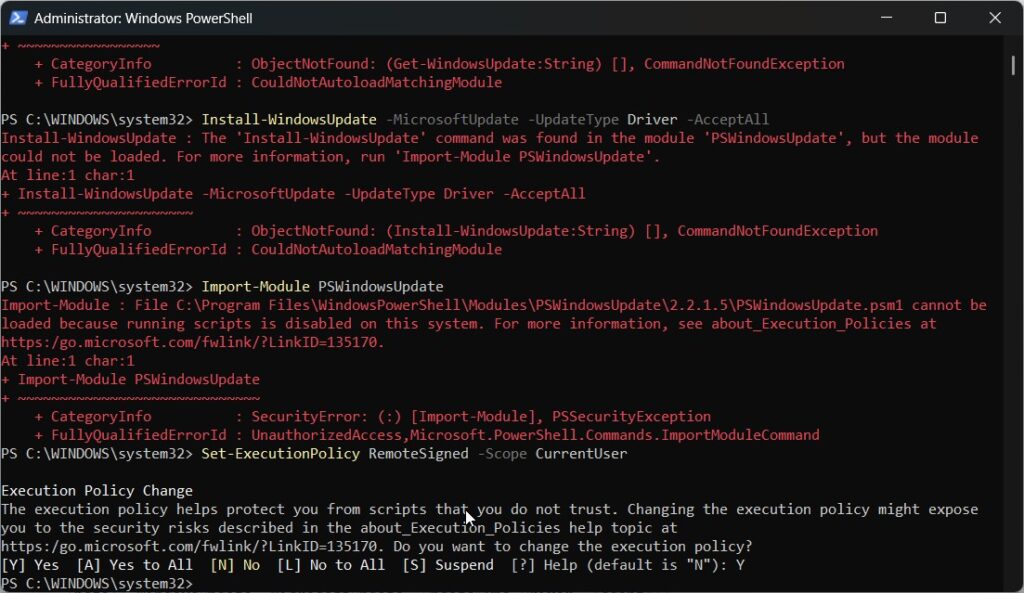
Step 2—Verify what’s available, drivers included.
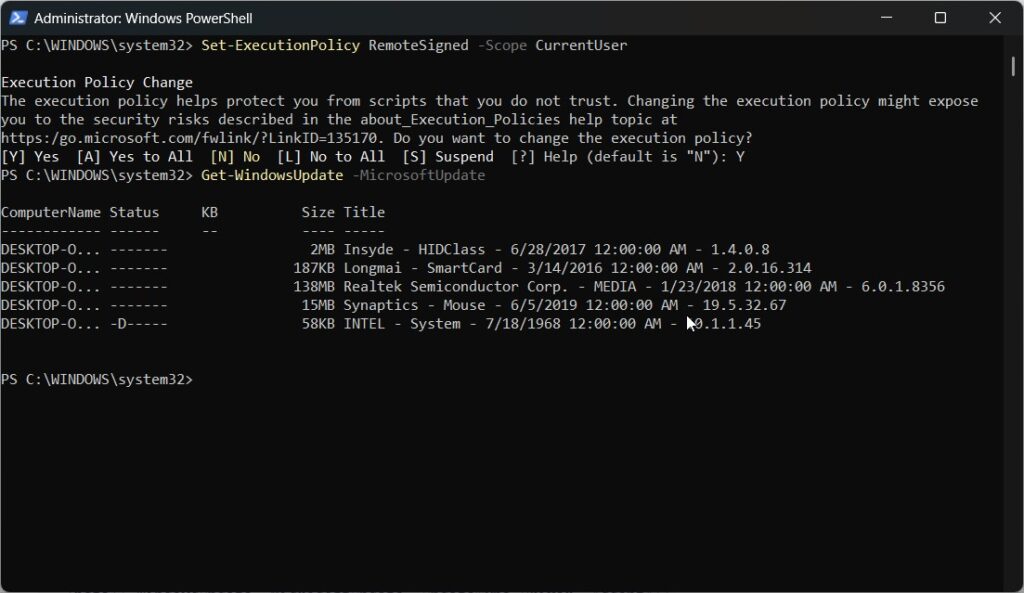
Get-WindowsUpdate -MicrosoftUpdateStep 3 — Install the driver updates:
Install-WindowsUpdate -MicrosoftUpdate -UpdateType Driver -AcceptAllThis downloads and installs the driver updates Microsoft distributes through Windows Update — the same ones the Settings app would fetch, but scriptable and hands-off. For IT admins, this is the real Windows command to update all drivers across many machines.
The honest caveat: PSWindowsUpdate only installs Microsoft-approved driver versions. For the absolute latest GPU drivers, you still want NVIDIA, AMD, or Intel’s own installers—Windows Update lags a version or two behind on graphics.
How to Verify Your Driver Updates Worked
After any method, confirm the changes. In PowerShell:
Get-WmiObject Win32_PnPSignedDriver | Select-Object DeviceName, DriverVersion, DriverDate | Sort-Object DeviceNameThe command lists every device with its current driver version and date, so you can confirm the updates have taken effect. Or open Device Manager, expand a category, and right-click a device → Properties → Driver tab to check its version.
Restart your PC afterward—a reboot isn’t always required, but it’s strongly recommended after updating core drivers like graphics, audio, or chipset so the changes fully take effect.
Does This Work on Windows 10 Too?
Yes. Every command here—the cmd command to update all drivers in Windows 11 and the cmd command to update all drivers in Windows 10—is identical on both. pnputil, DISM, and PSWindowsUpdate all work the same across Windows 10 and 11. There’s no separate update for all drivers’ Windows 11 cmd syntax to learn; the commands are version agnostic.
Best Practices
- Always run the prompt as administrator; otherwise, commands fail silently.
- Create a restore point before bulk-installing drivers, so you can roll back cleanly.
- Extract driver packages to a folder first—pnputil needs INF files, not EXE installers.
- Use Pnputil for a live PC, DISM only for offline images.
- Reboot after updating graphics, audio, or chipset drivers.
Common Mistakes to Avoid
- Don’t believe in a single “update all drivers” command. It doesn’t exist; use the three-tool toolkit.
- Running DISM /Add-Driver on your live system will not download drivers from the web. DISM installs local packages to images; it doesn’t fetch updates.
- Pointing pnputil at a folder of .exe installers. It needs the extracted .inf files.
- Forgetting admin rights. The number one reason a command prompt to update drivers appears to do nothing is that it’s not actually doing anything.
- Skipping the reboot after core driver changes.
Recommended Tools
- pnputil—built into Windows; the bulk INF installer.
- DISM — built in; offline image driver servicing.
- PSWindowsUpdate — a free PowerShell module that downloads driver updates from Windows Update.
- Device Manager — visual verification of installed versions.
Everything except the PSWindowsUpdate module ships with Windows.
How do I update drivers using CMD without third-party software?
Use built-in tools. Run pnputil /add-driver "folder\*.inf" /subdirs /install to install driver packages you have on disk, or use PowerShell’s PSWindowsUpdate module to pull Microsoft-approved updates from Windows Update. Both avoid third-party updater apps entirely.
What is the pnputil command to update all drivers?
The command must be run in an admin Command Prompt. The /subdirs flag reaches nested folders and /install applies the drivers to matching devices. It installs every valid driver package in the folder — the true bulk-update command for a running PC.
Does the cmd command to update all drivers work on Windows 10 and 11?
Yes, pnputil, DISM, and PSWindowsUpdate behave identically on Windows 10 and Windows 11. There’s no separate syntax—the same command to update all drivers works across both versions, since these are core Windows tools that haven’t diverged between the two.
Can CMD update my graphics driver to the latest version?
Only partly. PSWindowsUpdate installs the Microsoft-approved GPU driver, which usually lags a version or two behind. For the newest NVIDIA, AMD, or Intel graphics drivers, download from the vendor’s site and install with their installer or pnputil. Windows Update is reliable but not cutting-edge for GPUs.
How do I check which drivers are outdated before updating?
Run it pnputil /enum-drivers in an admin prompt to list every third-party driver with its version and date, or use it Get-WmiObject Win32_PnPSignedDriver in PowerShell for a full device-and-version table. Compare versions against the vendor’s site to spot outdated ones before you update.
Conclusion
Learning to update drivers using CMD comes down to abandoning one myth and adopting three tools. There’s no single command that updates everything, but PnPUtil installs your driver packages in bulk, DISM handles offline images, and PowerShell’s PSWindowsUpdate downloads Microsoft-approved updates straight from the command line.
For most people on a normal PC, the workflow is simple: Use PSWindowsUpdate to pull what Windows Update offers and PnPUtil to install anything you’ve downloaded manually. That combination brings nearly every driver current without a single third-party app.
Open an admin Command Prompt today, run pnputil /enum-drivers to see what you have, and pick the method that fits. Then tell us in the comments which command did the job for you—the honest, no-magic-button approach is the one that actually works.