
Last Updated:
You encounter the 0xc000000e error code on Windows 10/11 when there is a problem with the boot loader or wrong boot configuration data.
Error code 0xc000000e stops your PC completely. You press the power button, and instead of Windows loading, a black or blue recovery screen appears—”Your PC needs to be repaired. A required device isn’t connected or can’t be accessed.”
This is a boot-level failure. Windows cannot find or load the files it needs to start—specifically winload.exe or winload.efi, depending on your firmware type.
If you have multiple disks, only one of them is the boot disk.
So, the boot configuration data is stored on one disk of all the related settings to boot different Windows OSs.
Even though you use bootrec commands to fix the boot-loading options, it is important that you change the order of the boot disk. You can have either the Metro or Windows 7 bootloader, but the cause of the problem is the same.
The typical error message for 0xc000000e will be like this—
Recovery
Your PC/device needs to be repaired…
File: \Windows\system32\winload.efi
Error Code: 0xc000000e
This error error can appear when your Windows 10 OS was deleted on one HDD, which is the boot drive. The boot order options could also have changed.

I’ve worked through this error on dozens of systems—home desktops, office laptops, and freshly cloned SSDs. In every case, the solution comes down to one of three root causes: a corrupted Boot Configuration Data (BCD) file, a wrong boot order in BIOS, or a damaged EFI system partition.
For example, having two disks, like the Samsung 850 Evo 1TB and the Samsung SM951 M.2 NVMe 128GB, can complicate the issues.
You may get confused and think that the problem is with the hardware or some software. But many a time the real problem is with the bootloader configuration stored on your disk.
In this guide, I’ll walk you through 7 confirmed methods to fix error 0xc000000e on both Windows 10 and Windows 11. These methods cover every known scenario in 2026, including the increasingly common post-clone boot failure and the bootrec /fixboot access denied problem on UEFI systems.
What Is Error Code 0xc000000e?
The Exact Error Message You See
The full error screen looks like this:
Recovery
Your PC/Device needs to be repaired.
A required device isn't connected or can't be accessed.

File: \Windows\system32\winload.efi
Error code: 0xc000000e
On older systems using Legacy BIOS, the file path shows winload.exe instead of winload.efi. Both point to the same root cause—Windows Boot Manager cannot locate or load the startup file.
winload.exe vs. winload. EFI—What Is the Difference?
winload.exe is used by Legacy BIOS (MBR) systems. winload.efi is used by UEFI (GPT) systems — the default on all modern PCs since 2012 and on all Windows 11 systems.
If your error shows winload.efi, your PC is UEFI-based. The fix path is different from older guides that only cover MBR/Legacy systems.
What Causes the 0xc000000e Boot Error?
Corrupted or Missing BCD File
The Boot Configuration Data (BCD) file tells Windows Boot Manager where to find the OS files. If the BCD is corrupted, missing, or pointing to the wrong drive, Windows throws 0xc000000e and cannot proceed.
Wrong Boot Order in BIOS/UEFI
If you have multiple drives—an SSD and an HDD— BIOS might try to boot from the wrong one. The drive containing Windows must be first in the boot order.
0xc000000e After Cloning a Drive
This is the most common 2025–2026 trigger. When you clone a drive to a new SSD, the BCD still points to the old drive’s partition identifiers. Windows tries to boot, cannot locate the referenced partition, and throws 0xc000000e.
The fix is not bootrec—it requires bcdboot with UEFI flags.
Secure Boot Conflict on Windows 11
A Windows 11 feature update that changes boot file signatures can conflict with Secure Boot settings — especially on older OEM laptops. This causes 0xc000000e after a Windows Update reboot.
Failed Windows Update or Interrupted Installation
A Windows update interrupted mid-installation—due to power loss or forced shutdown—can leave the BCD in a partial state, causing the error on every subsequent boot.
How to Fix Error Code 0xc000000e (7 Methods)
You will need a Windows 10 or Windows 11 bootable USB drive for Methods 2 through 6. Create one using the Media Creation Tool from another PC if you don’t have one.
Method 1 — Change Boot Order in BIOS/UEFI
This is the fastest fix. Try it first.
- Restart your PC and press the BIOS key at startup—usually F2, F10, DEL, or ESC
- Navigate to the Boot tab or Boot Order section
- Move your Windows drive (SSD or HDD containing Windows) to first position
- Press F10 to save and exit
- Let the PC restart normally
If you have multiple drives, also confirm that the correct UEFI boot entry is selected — not the Legacy/CSM option for that drive.
Method 2 — Run Windows Startup Repair
- Boot from your Windows USB drive
- Select your language → click Repair your computer
- Click Troubleshoot → Advanced Options → Startup Repair
- Let it run — it may take 10–15 minutes and restart multiple times
- If it reports “Startup Repair couldn’t repair your PC”, proceed to Method 3
Method 3 — Rebuild BCD Using bootrec Commands
- Boot from Windows USB → Repair your computer → Troubleshoot → Advanced Options → Command Prompt
- Run these commands in order:
bootrec /fixmbr
bootrec /fixboot
bootrec /scanos
bootrec /rebuildbcd- When prompted to add an installation to the boot list, type Y and press Enter
- Type
exitand restart
Important: On UEFI/GPT systems, it
bootrec /fixbootoften returns “Access is denied. ” If that happens, skip to Method 4.
Method 4 — Fix “bootrec /fixboot Access Denied” on UEFI Systems
This is the most important fix for Windows 11 and modern UEFI systems—and the one most guides miss.
Open the Command Prompt from the recovery USB and run:
diskpart
list disk
select disk 0
list vol
Look for the FAT32 volume—that is your EFI System Partition. Note its volume number (e.g., Volume 2).
select vol 2
assign letter=Z
exit
Now run:
cd /d Z:\EFI\Microsoft\Boot\
bootrec /fixboot
This mounts the EFI partition before running fixboot, which resolves the access denied error.
Method 5 — Rebuild Boot Files with bcdboot for UEFI (Post-Clone Fix)
This is the definitive fix for 0xc000000e after cloning a drive and also works when bootrec fails completely.
From the recovery command prompt (EFI partition assigned to Z: from Method 4):
bcdboot C:\Windows /s Z: /f UEFIThe command rebuilds the entire boot environment from scratch, pointing to the correct Windows installation. Replace C: with the actual drive letter of your Windows partition if different—run dir C:\ to confirm Windows files are present.
Restart—the error should be gone.
Method 6 — Run SFC and DISM from Recovery Environment
If it winload.efi itself is corrupted—not just the BCD—you need to repair the system file.
From the Command Prompt in recovery:
sfc /scannow /offbootdir=C:\ /offwindir=C:\WindowsThen run:
DISM /Image:C:\ /Cleanup-Image /RestoreHealthPlease replace C: with your actual Windows drive letter. Restart after completion.
Method 7 — Disable Secure Boot in BIOS
If the error appeared after a Windows 11 feature update, Secure Boot may be rejecting a modified boot file.
- Restart → enter BIOS (F2/F10/DEL)
- Navigate to Security or Boot tab
- Find Secure Boot → set to Disabled
- Save and exit with F10
- Attempt to boot Windows
If Windows loads successfully, re-enable Secure Boot after ensuring all Windows updates are current.
0xc000000e on Windows 11 — Specific Notes
The bootrec /fixboot access denied problem is almost universal on Windows 11 because all Windows 11 systems are UEFI/GPT by requirement. Do not waste time repeating bootrec commands—go directly to Method 4 or Method 5.
The post-clone scenario is also far more common in 2025–2026 as users upgrade to NVMe SSDs. If you cloned your old HDD to a new SSD and got this error, Method 5 (bcdboot UEFI) is your solution—it takes under 2 minutes once you have the recovery USB ready.
Real Users Who Fixed Error 0xc000000e
1. Microsoft Community Hub—winload.efi Missing After SSD Issue (November 2024)
“Messed up the SSD while trying to recover lost data. bootrec /rebuildbcd returned 0 installations. Fixed by assigning a letter to the EFI partition in diskpart and running bcdboot C:\Windows /s V: /f UEFI. Back up and running in 20 minutes.” — Microsoft Community Hub, November 2024
2. Windows Forum — EFI Partition Assign Fix
“bootrec /fixboot kept returning access denied on my Windows 11 UEFI system. The fix was to use diskpart to assign the EFI partition a drive letter, then cd into the EFI\Microsoft\Boot folder before running fixboot. Worked perfectly.” — WindowsForum.com community thread, 2024
3. ElevenForum — Ubuntu SD Card Corruption Fixed
“Installing Ubuntu on an SD card corrupted my EFI partition. bcdedit returned blank output. The bcdboot C:\Windows /s V: /f UEFI command after manually assigning the EFI volume saved my Windows 11 installation without data loss.” — ElevenForum community, November 2024
4. Reddit r/buildapc — Post-Clone Boot Fix
“Got 0xc000000e after cloning to a new NVMe. bootrec /rebuildbcd found 0 installations. Running bcdboot from the recovery environment with the /f UEFI flag fixed it instantly. The key is pointing it at the right Windows partition.” — Reddit r/buildapc community
5. Microsoft Q&A — HP Laptop Startup Fix
“My HP laptop threw winload.efi 0xc000000e after a Windows 11 update. Disabled Secure Boot in BIOS, ran Startup Repair from recovery USB, re-enabled Secure Boot after. Back to normal with no data loss.” — Microsoft Q&A community, 2024
Windows 10/11 error code issue.
- A required device isn’t connected or cannot be accessed
- The required device is inaccessible
- The selected entry could not be loaded
- The selected entry could not be loaded because the application is missing or corrupt
- The boot selection failed because a required device is inaccessible.
Source: thewindowsclub.com
As you can see above, the real cause for this error code 0xc000000e is either the winload.exe file is not accessible or is corrupt, or the boot loader location of Windows 10 is not accessible.

Will disabling Secure Boot fix 0xc000000e on Windows 11?
It can — especially if the error appeared after a Windows 11 feature update that modified boot files. Disable Secure Boot in BIOS, run Startup Repair from recovery USB, then re-enable Secure Boot after a successful boot.
How do I fix 0xc000000e on Windows 10 with Legacy BIOS?
Boot from Windows 10 USB, open Command Prompt, and run bootrec /fixmbr, bootrec /fixboot, bootrec /scanos, bootrec /rebuildbcd in sequence. On Legacy BIOS systems, bootrec /fixboot works directly without the access denied issue.
How do I fix 0xc000000e on Windows 11 without losing data?
Boot from a Windows 11 USB drive, open Command Prompt from recovery, assign a letter to your EFI partition using diskpart, then run bcdboot C:\Windows /s Z: /f UEFI. This rebuilds the boot environment without touching your personal files.
What does error code 0xc000000e mean?
Error 0xc000000e means Windows Boot Manager cannot find or access winload.exe or winload.efi — the files needed to start Windows. It is caused by a corrupted BCD file, wrong boot order, or damaged EFI system partition.
How to Fix Error Code 0xc000000e in Windows 10
You can try the following solutions to resolve this issue.
- Change the boot order of the disk if you have multiple disks like HDD and SSD.
- Use the Windows 10 Startup Repair feature with the installation disk.
- Apply BCD command to rebuild it manually
- Make your disk online.
- Try third-party software
Most of the time, the above fixes will show you the way to solve error code 0xc000000e in Windows 10.
Change the Boot Order in BIOS
The first preliminary fix is to check whether the boot disk is the first disk loading during booting.
This can be done by changing the options in BIOS.
Most of the time, pressing the F2 or F12 or F10 or ESC or DEL keys during booting will take you to BIOS settings.
The procedure depends on your PC manufacturer model and the BIOS software you are using.

For example, on the Phoenix AwardBIOS CMOS setup utility, under “Advanced BIOS features,” you have the following options.
- Hard Disk Boot Priority
- First Boot Device
You can have multiple devices like USB, DVD, HDD, etc., connected to your PC.
- First, make sure your HDD is the first boot device.
- If you have multiple hard disks or solid-state drives on the same system, then you have to use Hard Disk Boot Priority.
- Go to the first option and press Enter. Then select the disk that is your boot disk and press F10.
It will save your changes and restart. If nothing is corrupt, you should be able to fix error code 0xc000000e and enter Windows 10.
Use Startup Repair in Windows 10 Installation Disk
Create a bootable Windows 10 installation disc. The medium could be either a DVD or USB. You can use a utility like Rufus to boot from USB. Otherwise, you can use software like MagicISO to boot from DVD.
Insert the appropriate hardware and change the BOOT options to load from it, as mentioned above. The BOOT options refer to the settings in the computer’s firmware that determine the order in which devices are used to start the operating system.
Source: https://www.laptopmag.com/articles/windows-10-advanced-startup-options-menu
The installation disc will boot up and select language and keyboard layout. Click Next. You will be taken to the next screen. On this screen, at the bottom, you see “Repair your computer.”
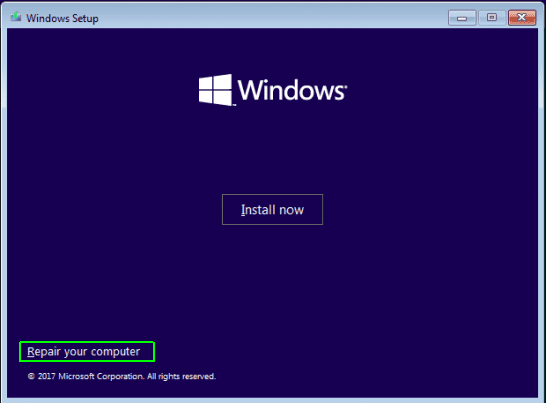
Then click “Troubleshoot” > “Advanced Options” > Startup Repair.

If it’s a small issue, this procedure will fix problems that keep Windows from loading. This will also automatically solve the 0xc000000e error, as a startup problem is the main cause for this issue.
Rebuild BCD manually
This solution is appropriate if the problem is due to a corrupt boot loader. If the boot configuration data has been erred by some hardware change, then the BCD commands will fix this. This is the most common solution for error code 0xc000000e and many times solves the problem.
- Boot using the Windows 10 installation disc.
- Then go to “Advanced options.”
- But this time select “Command Prompt.”
- Enter the following commands one by one.
bootrec /fixboot
bootrec /scanos
bootrec /fixmbr
bootrec /rebuildb--
Upon completion of each command, you will get a successful message. If you get any other error message, then you can try these troubleshooting steps.
Access is denied while applying the fixboot command.
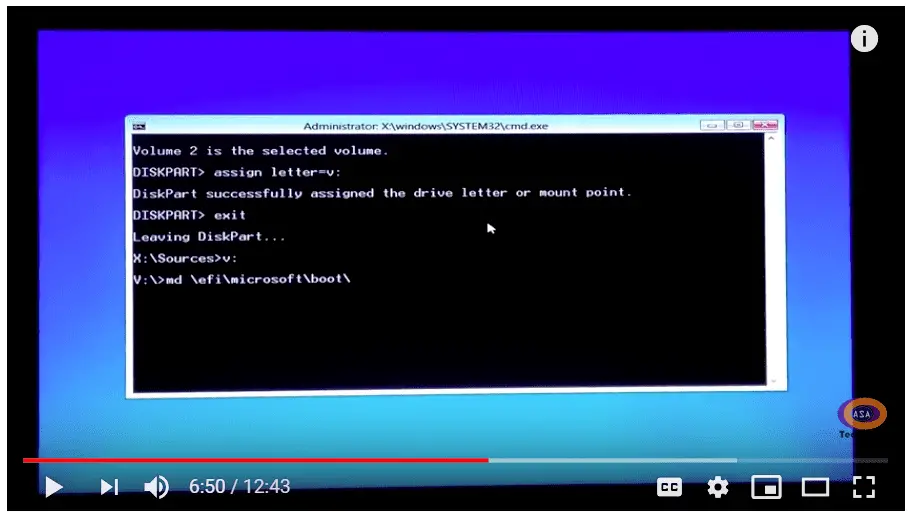
Then you have to type the following commands in the Command Prompt.
Step 1: Type diskpart and press Enter key.
Step 2. Type “list disk” and press Enter. Now check the disk number to identify the boot disk; this is usually Disk 0. If not, use the correct boot disk number.
Step 3. Type “select disk 0” (or your boot disk number) and press Enter.
Step 4. Type the list volume and press Enter. Now look for the volume number of the EFI partition.
Step 5. Type “select volume 1” and press Enter. (Change volume to your number.)
Step 6. Type assign letter=V: and press Enter. V: can be replaced by any drive letter that is not in use by any partition.
Step 7. Type exit and press Enter.
Step 8. Now type V: (or the drive letter you just assigned) and hit Enter.
Step 9. Type md \efi\microsoft\boot\ and hit Enter.
Step 10. Type — /d V:\efi\microsoft\boot\ and hit Enter.
Step 11. Now type the bootrec /fixboot command; the problem should be solved now.
Step 12. b–boot c:\windows /l en-us /s V: /f all
The YouTube video below shows how to fix the “Access is denied” error when using the Fix MBR command.
If you have multiple OSs on the same PC, you can add all of them to the new boot configuration. A prompt with different options is displayed during the /scanos command.
If the process still fails to boot your computer, then the correct order of the boot disc is the problem.
Using the BIOS settings, you must perform trial and error to identify the correct disc containing the boot loader.
This issue happens when you have multiple disks.
Make the Boot Disk Online and Scan Disks
Sometimes, the boot drive can go offline and is not added to the boot loader settings. Then you have to apply the following commands.
In the Command Prompt of your Repair Disc or Installation Disc, as mentioned before, enter the following commands.
- diskpart
- list disk
- list volume
- select disk # (or) select volume #
- online disk # (or) online volume #
Press Enter and restart the computer.
Use EasyBCD-kind of repair software
There is several third-party software that will recover your corrupted boot loader. They will also scan the disks and do other functions. They are a kind of repair software. You just have to boot them using a USB or DVD and make the disc bootable.
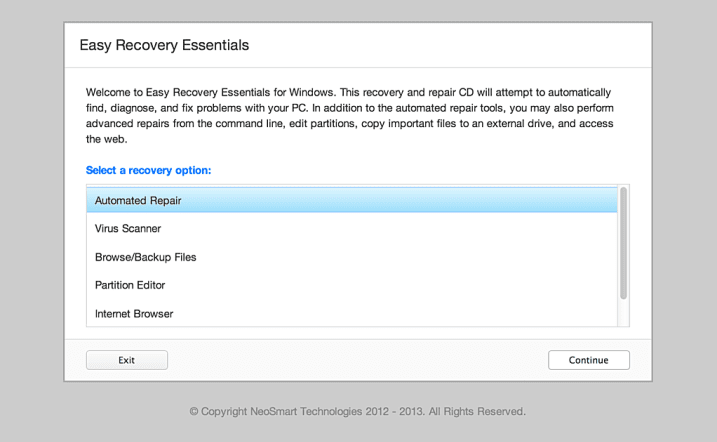
Once loaded, find the right options to regain your old boot order. The program can check your hard disk for bad sectors and also make the correct drive bootable. The following are some of the software.
- Easy Recovery Essentials
- AOMEI Partition Assistant
- EasyBCD
Case studies
I just upgraded to Windows 10 on my laptop from Windows 7 on a solid drive. All seemed to work fine at first, then I had this boot failure problem.
“Recovery
Your PC need to be repaired
File: \Windows\system32\winload.exe
Error Code: 0xc000000e
You’ll need to use the recovery tools on your installation media, etc.
Press Enter to try again
Press F8 for Start-Up Settings.”
I updated my Windows 10 OS a few days back due to the forcible prompts to update.
My laptop went out of power completely yesterday, and after that I got the error code 0xc000000e during startup.
Tried many options like below:
– bootrec /fixmbr
– bootrec /fixboot –> Got Access is denied at this step
– bootrec /rebuildb– –> Total identified Windows installations: 0The 2 TB SATA drive is not being recognized. I have important data on the hard drive; any ideas how to recover the data by a repair?
My Final Thoughts
As you can see, the main cause of this error code 0xc000000e is installing the winload.exe on each OS and repairing the boot configuration data. Then load the correct boot hard drive, and you are back to normal.
Error code 0xc000000e looks severe but is fixable in most cases without reinstalling Windows. Start with the boot order fix — it solves the problem in about 30% of cases. If that fails, the bootrec CMD sequence and bcdboot UEFI method handle the majority of remaining cases.
For Windows 11 users experiencing the issue after a feature update or SSD clone, Method 5 (bcdboot UEFI) is your most reliable path. If you fixed your system using one of these methods, drop a comment below — your experience helps other Windows users in the US, UK, and India find the right fix faster.
If you can rebuild the MBR (Master Boot Record) using the bootrec commands, then this error code will disappear. But occasionally, you may get an error like “access is denied,” which can be fixed as mentioned above.
If you have resolved your error, please share your experience in the comment section below.

Your very basic C prompt bootrec /xxxxx commands fixed my primary computer while other fixes I researched were too fast to follow and rather convoluted. I thank you so much. If you will provide me your email address I’d be pleased to send you a monetary token of my appreciation for your help. Thanks.
rsa
—
@Anderson. Thanks that my solution helped. It exists from Windows 7 onwards. Only I have contributed to a good presentation. Please check your email.
Awesome. I have got both HDD and SSD on my laptop, and changing boot option was worked for me. Thank you very much for help
Great. It helped.