
Last Updated:
Here are ways to fix Outlook when it stops working or is unresponsive.
1. If your profile is corrupted, startup errors can occur. To resolve the issue, you can either use Outlook recovery software or create a new profile completely. But I would prefer the latter. Then re-add the email accounts.
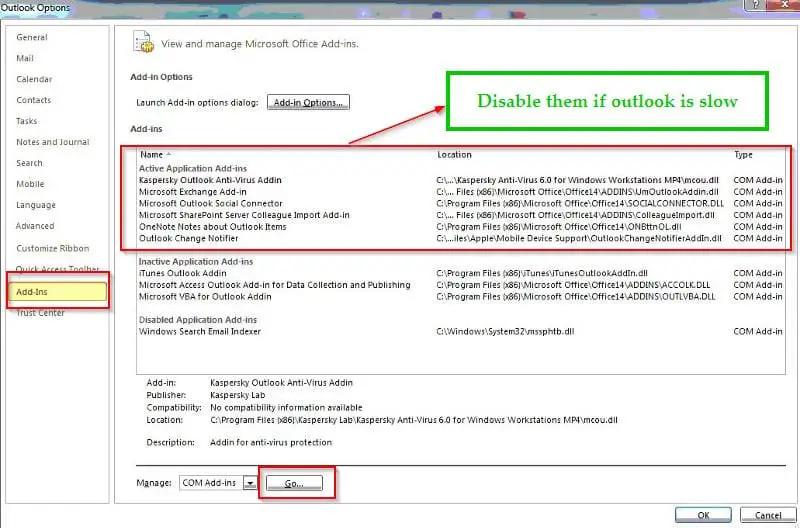
2. As mentioned before, add-ins are a hindrance to Outlook, and they slow the startup. So if you think they are compulsively necessary, then only keep them; otherwise, disable them.
3. Whether it’s Outlook 2016, 2013, or 2010, you will get updates along with Windows. The process is the same in 10, 8.1, and 7.
So if you have a graphics card, printer, DVD writer, etc., you need drivers to make them work properly.
In earlier versions of Windows like XP, you need to go to the manufacturer’s website or use the given CD to install them. But now with 10, they are available with the updates.
4. Repair, uninstall, and reinstall Office completely to solve the problem permanently if Outlook has stopped working.
Source: experts-exchange.com
Outlook 2016 has different features like mail, calendar, people, tasks, etc. Even if one is not working, that does not mean your Outlook has stopped working.
You can find other problems like Outlook not starting, being slow in responding, profiles not being created properly, corruption of archive files, etc. Each one has its own solution. You can try the following solutions to make Outlook 2016 work perfectly and have no performance issues.
Details of the solutions for Outlook 2016 crashes
1. The first and straightforward solution if you discover Outlook is not working is to uninstall Office and reinstall again.
After uninstallation, make sure you clean the leftover registry entries with CCleaner. This should clean any corrupted items in the registry.
You can also try to resolve Outlook 2016 by using the Change option, which repairs Office 2016. Then try to reinstall Office again. This should resolve any startup and slowness errors.
2. When you install Outlook 2016, it automatically adds several add-ins, such as application add-ins and COM add-ins. To disable these add-ins, you need to start Outlook 2016 in safe mode. This can be done in the following way:
Start > Run. Type “outlook/safe” (don’t put any space) and press Enter.
You should verify the title bar if Outlook has started in safe mode. It will show something like Microsoft Outlook 2016 (Safe Mode).
To disable the add-ins, you can do the following.
1. File > Options > Add-ins
2. In the following dialog box, select any type of add-ins like application add-ins and click Go.
3. If any add-ins are checked, uncheck them.
4. Restart Outlook in normal mode.
If Outlook starts normally, then that add-in is the culprit. If it doesn’t, then you uncheck each other’s add-ins in different categories. This will rule out the problem of add-ins causing Outlook 2016 not to work in Windows 10.
3. Sometimes the problem may lie with device drivers not working properly in Windows 10. The issue can be resolved by updating the drivers or using any third-party tool that automatically finds all the relevant drivers for that software and updates them.
As a general measure, you can also do the following.
For Windows 10.
1. Start > Settings > Update & Security > Windows Update.
Check online for updates.
If any of them are available, then update your OS.
Sometimes Outlook 2016 updates are also installed during this process. Microsoft sometimes releases these updates to repair any security or nonworking issues. Once the team patches up the issues, the system may start working again.
4. Another problem that you see less often in Outlook 2016 is that you cannot send or receive e-mail. This issue was seen in the earlier editions like 2007, 2003, and 2002.
Whenever you encounter this problem, please back up your existing profile if possible. Then create a new Outlook profile.
a. For this step, click User Accounts > Mail.
The Mail Setup dialog box will open.
Click Show Profiles. If a profile exists, please set it as the default profile. If that resolves the problem, continue.
Otherwise, delete that profile and create a new profile with the default settings. Then make it the default profile, which can be done as follows.
a. On the Mail dialog box, under the “When starting Microsoft Outlook, use this profile” box, click to select the profile you created. Click OK.
5. Another problem is that Outlook hangs up when you try to perform a task. For example, you try to archive and/or move a large number of messages at once.
This causes Outlook 2016 to operate in the background. Sometimes this looks as if Outlook is stuck. Please allow a few minutes for the process to complete. Then Outlook 2016 should start working again.
If not, try another solution.
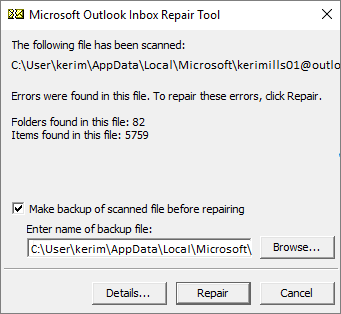
When you install Office 2016, an Inbox Repair Tool (SCANSPST.EXE) is also installed on your PC. The tool can scan your Outlook-related system and data files and repair errors.
To use this tool, go to the search box and type SCANPST.EXE.
Outlook 2016: C:\Program Files (x86)\Microsoft Office\root\Office16
Run the file. In the “Enter the name of the file you want to scan” box, you type the name of the .pst file that you want the tool to check. Otherwise, you can browse the file. Choose “Start” to begin the scan.
If the “Scan” finds the errors, choose the “Repair” option available at the bottom.
When the repair is complete, you use the “Profile,” which was working earlier, and Outlook should work properly.
6. Sometimes Microsoft Exchange Server, which works in office and large-scale environments, connects to Outlook 2016 through an offline Outlook Data file (.ost). This is a data file. It contains all the information saved on your mail server.
If you encounter any issues with this file, please refrain from attempting to repair it. Instead, delete the offline file and recreate it by downloading all of your items again from online mode.
7. For example, in Office version 1705 (Build 8201.2193 Click-to-Run), Outlook 2016 crashes on startup. It shows a message that says, “Microsoft Outlook has stopped working.” It registers an application log error 1000 with mso20win32client.dll as the faulting module.
You can try all the above fixes, like running online repair, creating new profiles, using Fix It tools, disabling third-party add-ins, etc., but the problem may not be resolved. This issue mainly occurs if your Outlook is in a network environment like Microsoft Exchange.
To resolve this issue, you can ensure that “Exchanged cache mode” is configured for each user. If you run in a Sophos environment, then you can disable this option under policies.
“Protect Office Applications.”
8. Another simple solution is to try out the following commands, which can resolve the issue.
cmd (run as administrator)
— %programfiles%\Common Files\Microsoft Shared\ClickToRun
officec2rclient.exe /update user updatetoversion=16.0.8431.2094
(8431.2094 brings office back to the beginning of October 2017.)1. Start Outlook.
2. Click File, and then click Office Account.
3. In the Product Information column, click Update Options, and then click Disable UpdatesSymantec Endpoint 14 latest service patches
Windows 10 1709 latest service packs
Office 2016 latest service packs
You can still keep the Symantec Endpoint Outlook. Add on enabled.

I’m very happy to read this. This is the type of manual that needs to be given and not the random misinformation that’s at the other blogs. Appreciate your sharing this greatest doc.