Last Updated:
In the realm of digital workspaces, a multi monitor taskbar in Windows 11 and 10 can dramatically improve your productivity. This system offers enhanced capabilities for managing multiple applications and windows.
A common feature users often seek is the ability to show the taskbar on all displays, which facilitates navigation and access across multiple monitors. This guide will walk you through the simple steps to enable this feature and make your workspace more efficient and user-friendly. If you’re still on Windows 7, this feature isn’t built in the same way—see the legacy method near the end for the real options.
Key Takeaways
- Windows 11 and 10 both support showing the taskbar on every connected monitor, controlled from Settings > Personalization > Taskbar > Taskbar behaviors.
- The setting is off by default in both versions—you have to turn it on manually; it doesn’t happen automatically when you connect a second screen.
- A registry method exists as a backup if the Settings toggle is greyed out or won’t save.
- A documented Explorer-crashing bug affects some multi-monitor setups in Windows 11; disabling the same setting is the current workaround.
- Windows 7 has no equivalent feature at all—it needs third-party software to get taskbar functionality on a second screen.
Quick answer
To show the taskbar on every monitor in Windows 11 or 10, right-click the taskbar, choose Taskbar settings, expand Taskbar behaviors, and turn on Show my taskbar on all displays.
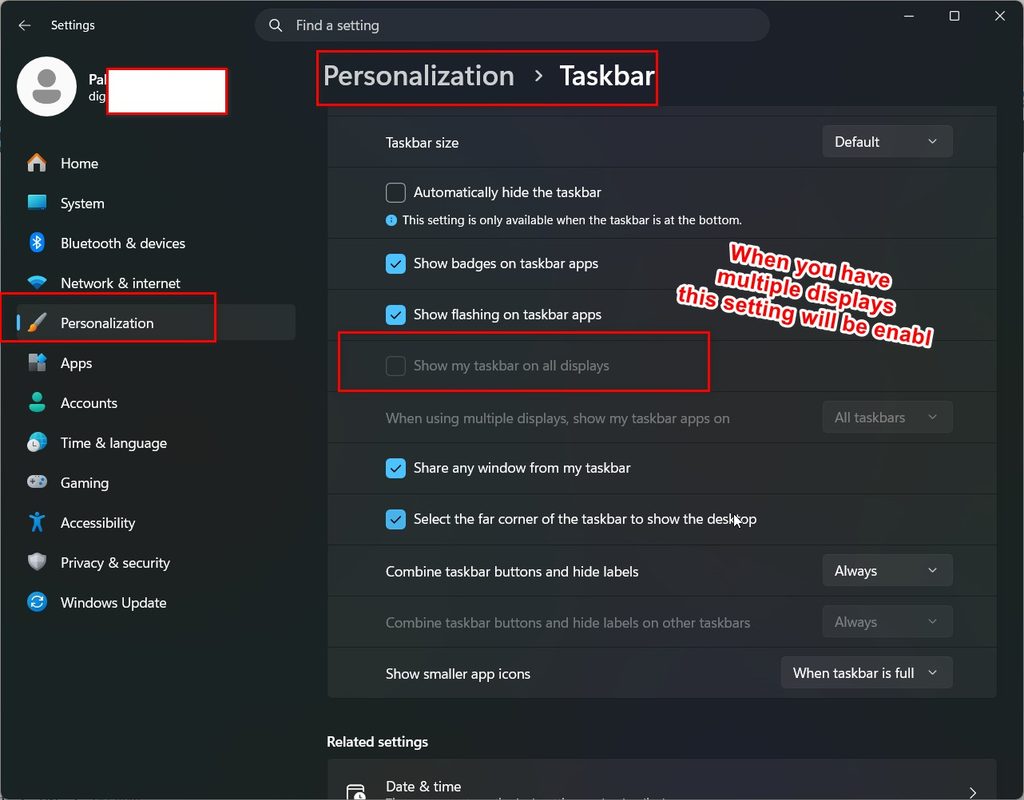
Then set When using multiple displays, show my taskbar apps on to All taskbars if you want every app icon visible on every screen.
I’ve set up more dual and triple-monitor desks than I can count over the years, and this is one of those settings almost nobody finds on their own the first time.
It’s buried a level deeper than most taskbar options, and the wording Microsoft uses (“Taskbar behaviors”) doesn’t exactly scream “this is where your second monitor’s taskbar lives.”
Here’s the full picture—how to turn it on, how to control what shows where, and what to do when it doesn’t behave.
How to Show Taskbar on All Displays in Windows 10
A key feature that enhances this setup is the ability to show the taskbar on all displays, which streamlines navigation and access to necessary tools and programs across multiple screens. This guide provides a straightforward approach to enabling this feature, ensuring a more connected and efficient multi-monitor environment.
Step 1: Access Taskbar Settings
Right-click on an empty area of the taskbar on your primary monitor. From the context menu that appears, select “Settings” to open the taskbar settings menu.
Step 2: Open Taskbar Settings
Once you are in the settings menu, scroll down to find the “Taskbar” section which contains various customization options for your taskbar.
Step 3: Locate the Multiple Displays Section
Within the Taskbar settings, scroll further down to reach the “Multiple displays” section. This section is specifically dedicated to settings that affect how your taskbar behaves across multiple monitors.
Step 4: Enable Taskbar on All Displays
In the “Multiple displays” section, you’ll find an option labeled “Show taskbar on all displays.” Toggle this switch to “On” to enable the taskbar to appear on each of your connected displays.
Step 5: Customize Taskbar Buttons
Directly beneath the toggle switch, you will see an additional setting “Show taskbar buttons on.” Here, you can choose how the taskbar buttons are displayed: on all taskbars, main taskbar and taskbar where window is open, or taskbar where window is open. Choose the option that best fits your workflow.
How Windows 11 and 10 handle multi-monitor taskbars
By default, both Windows 11 and Windows 10 only show the taskbar on your primary monitor. Connect a second screen, and nothing changes automatically—you have to turn the feature on yourself.
Once enabled, Windows gives you a taskbar on every connected display, but each one isn’t a fully independent copy. Some settings (auto-hide, taskbar alignment) apply globally across all taskbars, while others (which app icons appear where) can be configured per your preference.
How to show the taskbar on all displays in Windows 11
Step 1: Open Taskbar settings
Right-click any empty area of the taskbar and select Taskbar settings, or go to Settings > Personalization > Taskbar.
Step 2: Expand Taskbar behaviors
Scroll down and click Taskbar behaviors to expand that section — this is where the multi-monitor controls live in Windows 11.
Step 3: Turn on Show my taskbar on all displays
Toggle this on. The taskbar should immediately appear on every connected monitor.
Step 4: Choose how app icons display
A new dropdown appears once the toggle is on: When using multiple displays, show my taskbar apps on. You’ll have three choices:
- All taskbars – every open app’s icon shows on every monitor’s taskbar
- Main taskbar and taskbar where window is open – the primary taskbar always shows all apps; secondary taskbars only show apps open on that specific screen
- Taskbar where window is open – each taskbar only shows icons for apps actually open on that screen
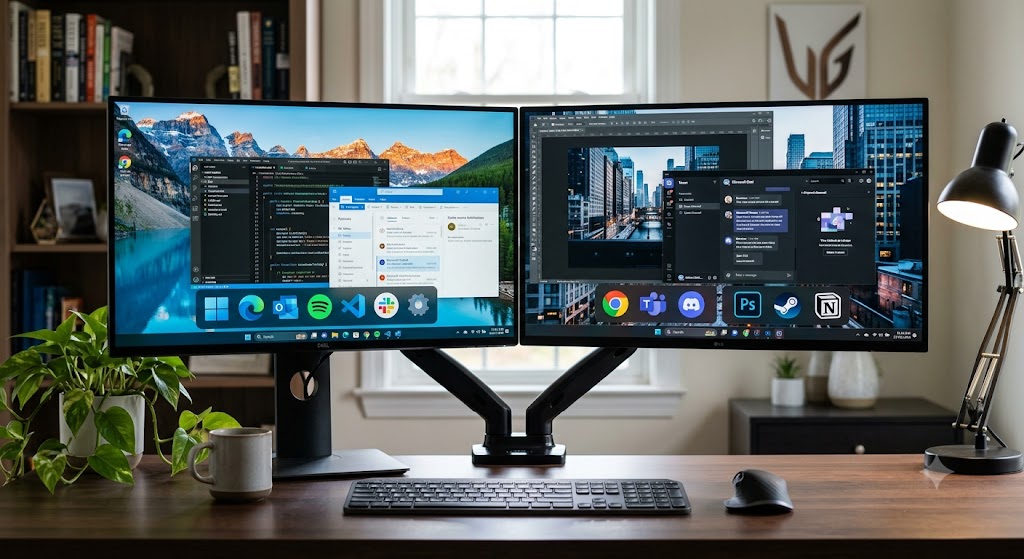
Most people find Taskbar where window is open the least cluttered option once they get used to it, since it keeps each monitor’s taskbar focused on what’s actually happening there.
How to show the taskbar on all displays in Windows 10
The steps are nearly identical, just without the “Taskbar behaviors” expandable section Windows 11 introduced.
Step 1: Open Taskbar settings
Right-click the taskbar and choose Taskbar settings.
Step 2: Scroll to Multiple displays
Scroll down to the Multiple displays section directly — there’s no extra expand step needed.
Step 3: Toggle Show taskbar on all displays
Turn this on.
Step 4: Set Show taskbar buttons on
Choose from the same three options described above for Windows 11.
Registry method (when the Settings toggle won’t work)
If the setting is greyed out, won’t save, or you need to script this across multiple office machines, the registry method works as a backup on both versions.
- Press Win + R, type
regedit, press Enter - Navigate to
HKEY_CURRENT_USER\Software\Microsoft\Windows\CurrentVersion\Explorer\Advanced - Right-click in the right pane, choose New > DWORD (32-bit) Value, and name it
MMTaskbarEnabled - Double-click it and set the value to
1 - Create a second DWORD named
MMTaskbarModeto control the app-icon behavior — set it to0for all taskbars,1for main taskbar plus window’s taskbar, or2for taskbar where window is open - Open Task Manager (Ctrl+Shift+Esc), find Windows Explorer under Processes, and select Restart
Back up the registry before editing it, as with any registry change.
Fixing the Windows 11 Explorer crash on multi-monitor setups
There’s a documented issue where Windows Explorer crashes repeatedly on some systems specifically when the multi-monitor taskbar is enabled. If your desktop keeps flickering, restarting, or Explorer keeps freezing after turning this feature on, the current known workaround is straightforward:
- Right-click the taskbar, open Taskbar settings
- Expand Taskbar behaviors
- Turn off Show my taskbar on all displays
- Restart Explorer via Task Manager
This isn’t a permanent fix — it’s a workaround that trades the multi-monitor taskbar for stability until Microsoft addresses the underlying bug in a future update. If you rely heavily on the multi-monitor taskbar, check your Windows Update history for a fix for this specific issue.
Why an app disappeared from one monitor’s taskbar
This scenario is one of the most common points of confusion, and it’s almost never actually a bug. If an app you had open on one screen seems to have vanished from that monitor’s taskbar, check the “When using multiple displays, show my taskbar apps on” setting first. If it’s set to Taskbar where window is open, an app will only show on the taskbar of the screen it’s actually open on — moving the window to another monitor moves its taskbar icon too. The app hasn’t closed; its icon is just following the window.
Multi-monitor taskbar: Windows 7 vs 10 vs 11 comparison
| Feature | Windows 7 | Windows 10 | Windows 11 |
|---|---|---|---|
| Native multi-monitor taskbar | Not supported | Supported | Supported |
| Setting location | N/A | Settings > Personalization > Taskbar | Settings > Personalization > Taskbar > Taskbar behaviors |
| Default state | N/A | Off | Off |
| Per-screen app icon control | N/A | Yes (3 modes) | Yes (3 modes) |
| Registry method available | N/A | Yes | Yes |
| Known stability issues | N/A | Rare | Explorer crash reported on some configurations |
By following these steps, you will have successfully configured your Windows 10 system to show the taskbar on all displays. This setup ensures that you have easy access to all your applications and tools across your multiple monitors, enhancing your productivity and multitasking capabilities.
Does Windows 7 support showing the taskbar on multiple monitors?
No, not natively. Windows 7 has no built-in option for this — you’d need third-party software like DisplayFusion or Actual Multiple Monitors. This native toggle is a Windows 10/11 feature only.
Does Windows 11 show the taskbar on all monitors by default?
No. Both Windows 11 and Windows 10 have this feature turned off by default — you need to manually enable it in Taskbar settings.
Why are the app icons missing from the taskbar on my second monitor?
Check the “When using multiple displays, show my taskbar apps on” setting. If it’s set to “Taskbar where window is open,” icons only appear on the taskbar of the screen the app is actually open on.
Why does Windows Explorer keep crashing after I turn on the multi-monitor taskbar?
This is a known issue affecting some Windows 11 configurations. The current workaround is disabling “Show my taskbar on all displays” and restarting Explorer until Microsoft resolves the underlying bug.
Windows 7 has no built-in setting at all for showing the taskbar on a second monitor — the feature was introduced starting with Windows 10. If you’re still on Windows 7 and need this functionality, you have two options.
Third-party software is the only way to get genuine multi-monitor taskbar functionality on Windows 7. Tools like DisplayFusion or Actual Multiple Monitors add a taskbar-style bar to secondary displays, complete with their own app icons and system tray.
A common point of confusion worth clearing up: “Extend” and “Duplicate” display modes are not the same thing, and neither one gives you a second taskbar on its own.
Duplicate your entire primary screen—including the taskbar — onto the second monitor exactly as-is. Extend creates a larger combined desktop across both screens, but the native Windows 7 taskbar still only appears on your primary monitor; extending the desktop doesn’t extend the taskbar with it. If you want an actual second taskbar under Extend mode, third-party software is required.
Best practices for a multi-monitor taskbar setup
- Start with Taskbar where window is open for app icons — it’s the least cluttered option for most multi-monitor workflows
- Confirm your displays are set to Extend, not Duplicate, before configuring taskbar settings (Win + P > Extend)
- Use Settings > System > Display > Identify to confirm which monitor Windows considers your primary display before enabling the feature
- If you experience crashes, disable the feature temporarily rather than assuming a full system problem — check Windows Update for a fix before troubleshooting further
- For office deployments across many PCs, use the registry method or Group Policy rather than manually configuring each machine
Common mistakes people make with multi-monitor taskbars
- People often assume that the feature turns on automatically when they connect a second monitor. It doesn’t—you have to enable it manually every time on a fresh Windows install.
- Confusing Extend and Duplicate display modes. Duplicate mirrors everything, including the taskbar; it isn’t a way to get a second independent taskbar.
- Not checking the app-icon display setting when an app “disappears.” This is almost always a display setting, not a crashed or closed application.
- Troubleshooting a crash as a hardware issue first. If Explorer is crashing specifically after enabling multi-monitor taskbars, the setting itself is the more likely cause—try disabling it before deeper hardware diagnostics.
- Trying to find this setting on Windows 7. It doesn’t exist natively on Windows 7 at all—no amount of searching Control Panel will find it, because the feature wasn’t introduced until Windows 10.
Recommended tools
- DisplayFusion—Third-party software that adds full taskbar functionality to any monitor, including on Windows 7, where the feature doesn’t exist natively
- Actual Multiple Monitors – An alternative third-party tool with similar multi-monitor taskbar and window-management features
- Windows Registry Editor (built-in)—For the registry method described above, useful for scripting across multiple office machines
If you’ve since upgraded to Windows 10 or 11, none of this applies—the native toggle covered earlier in this guide replaces the need for any third-party tool entirely.
Conclusion
A multi-monitor taskbar setup should feel invisible once it’s configured right—you shouldn’t have to think about which screen an app icon lives on or wonder whether Windows silently closed something.
Just turn on the setting, choose the app-icon behavior that matches how you actually work across your screens, and you’re done in under a minute.
If you hit the Explorer-crashing bug, don’t assume your hardware is at fault—disable the feature, confirm stability returns, and re-enable it once Microsoft ships a fix.
And if you’re still on Windows 7, save yourself the search through Control Panel: the native feature simply isn’t there, and third-party software is genuinely your only path to a working second-screen taskbar.