Category: Microsoft

  • Fix “Your Browser is Managed by Your Organization” in Microsoft Edge

    Fix “Your Browser is Managed by Your Organization” in Microsoft Edge

    If you’ve recently noticed the message “Your browser is managed by your organization” in Microsoft Edge, you’re not alone. This notification typically appears when your browser settings are being controlled by an organization, such as your workplace, school, or IT administrator.

    According to Microsoft’s official documentation, this feature is part of Edge’s enterprise management capabilities, allowing organizations to enforce policies, manage updates, and configure security settings to ensure compliance and protect sensitive data.

    For instance, your organization might restrict access to certain websites, enforce password policies, or disable specific extensions to maintain a secure browsing environment.

    While this message can be concerning for individual users, it’s important to understand that it’s not a sign of malware or unauthorized access.

    Instead, it reflects the use of Group Policy or Mobile Device Management (MDM) tools to manage Microsoft Edge settings. If you’re using a work or school device, this is standard practice.

    However, if you’re on a personal device and see the message “Edge managed by your organization”, it’s worth checking your system’s policies or consulting your IT department.

    By addressing this proactively, you can ensure your browsing experience remains secure and aligned with organizational requirements. For more insights, Microsoft’s support page offers detailed guidance on managing browser policies effectively.

    Why Does This Happen?

    The message suggests that browser settings are controlled by group policies. While these can be set by IT teams, software or configurations can also trigger them unintentionally.

    Causes, Conflicts, and Common Error Messages of “Your Browser is Managed by Your Organization” in Microsoft Edge

    The “Your browser is managed by your organization” message in Microsoft Edge can be confusing, especially if you’re using a personal device. This message typically appears when certain policies are applied to Edge, indicating external control over the browser settings. Here’s a breakdown of what causes this, conflicts that may arise, and common error messages associated with it.

    Causes:

    1. Group Policies: Organizations often use group policies to configure browsers for security, user restrictions, or custom settings. Even if the device isn’t work-issued, past configurations or software can introduce these settings.
    2. Software Installations: Some third-party software, particularly antivirus programs or extensions, can modify Edge settings, causing policy changes.
    3. Malware: Malware can exploit browser configurations, causing the system to display this message by enforcing policies without user consent.

    Conflicts:

    1. Restriction of Features: Policies can disable features like changing default search engines, preventing installations of specific extensions, or blocking access to certain settings.
    2. Browser Performance: Unwanted policies might cause performance issues, slowdowns, or frequent crashes.
    3. Privacy Concerns: Users may feel that their browsing is being monitored or controlled, leading to security concerns.

    Common Error Messages:

    1. “Some settings are managed by your organization.”
    2. “Your browser is managed by your organization.”
    3. “This setting is enforced by your administrator.”

    Understanding the causes and conflicts can help identify the best solutions to remove unwanted configurations and restore full control over Edge.

    Solution 1: Check Group Policies

    1. Press Windows + R, type gpedit.msc, and hit Enter.
    2. Navigate to Computer Configuration > Administrative Templates > Windows Components > Microsoft Edge.
    3. Identify and disable any policies managing Edge.
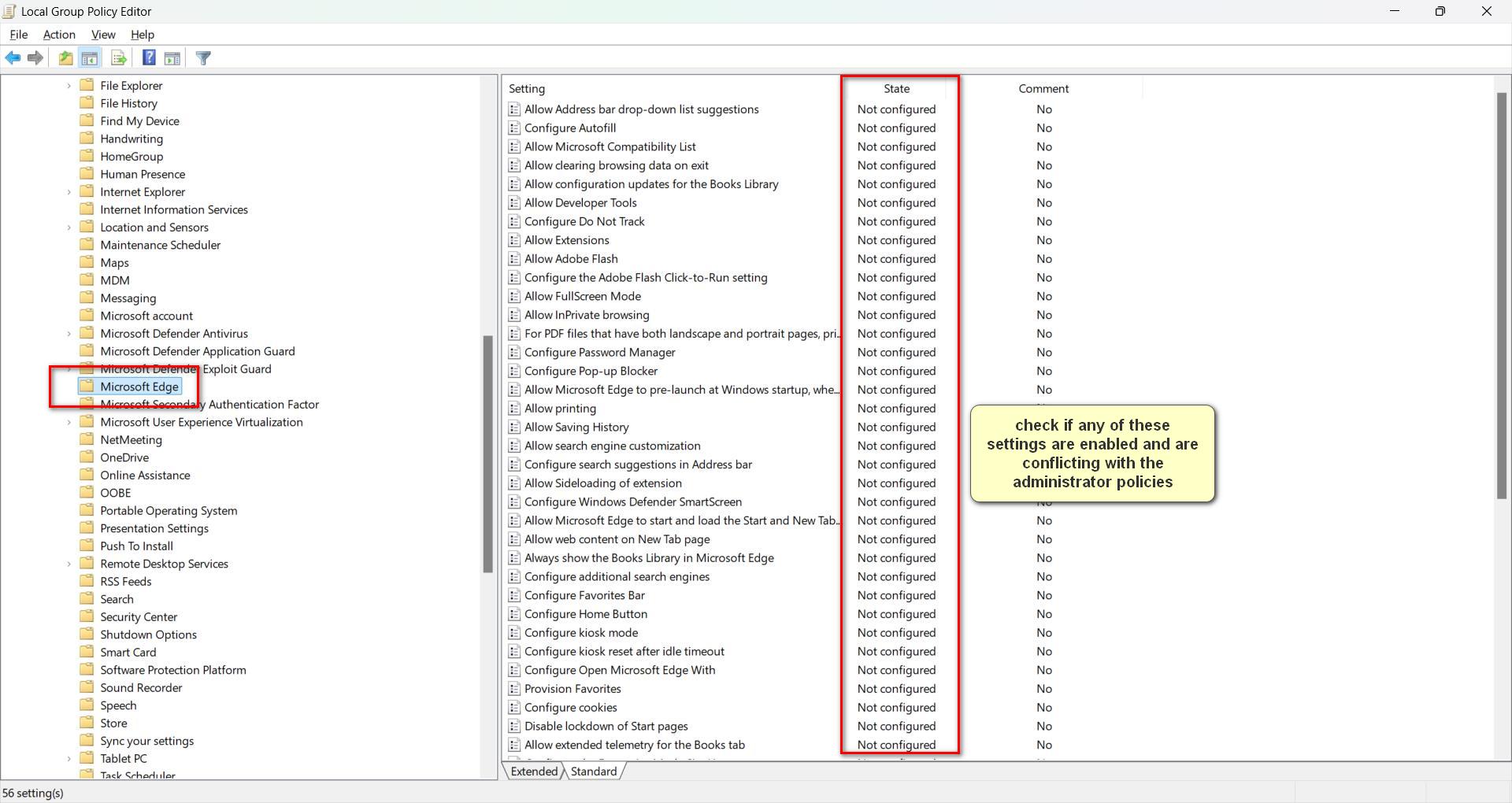
    Your Browser is Managed by Your Organization in Microsoft Edge solution windows 11

    Solution 2: Remove Configuration Profiles

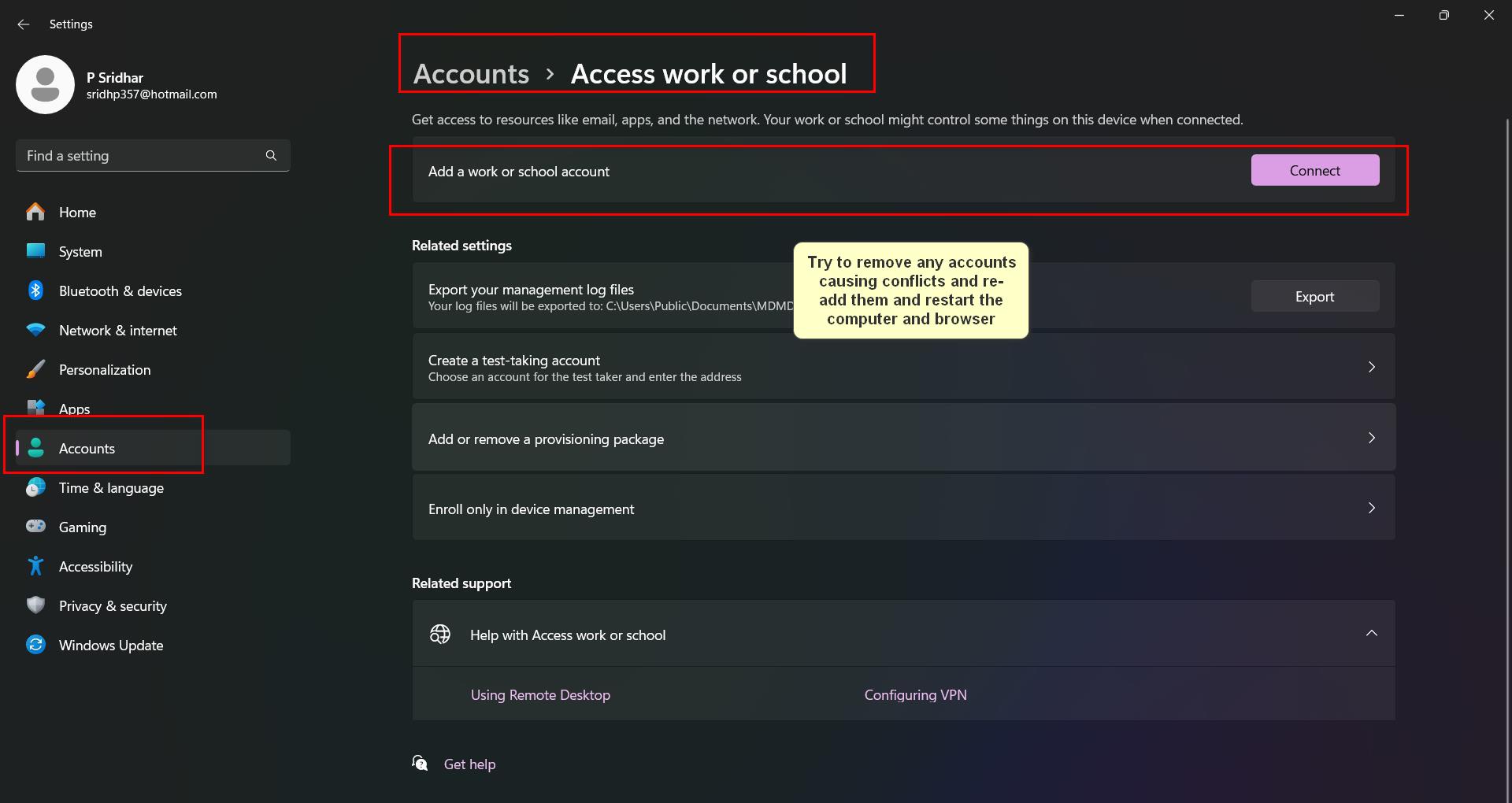
    1. Go to Settings > Accounts > Access work or school.
    2. Disconnect any accounts applying policies.
    Solution 3: Reset Browser Settings – Your Browser is Managed by Your Organization

    1. Open Edge settings > Reset Settings.
    2. Click on Restore settings to their default values and confirm.

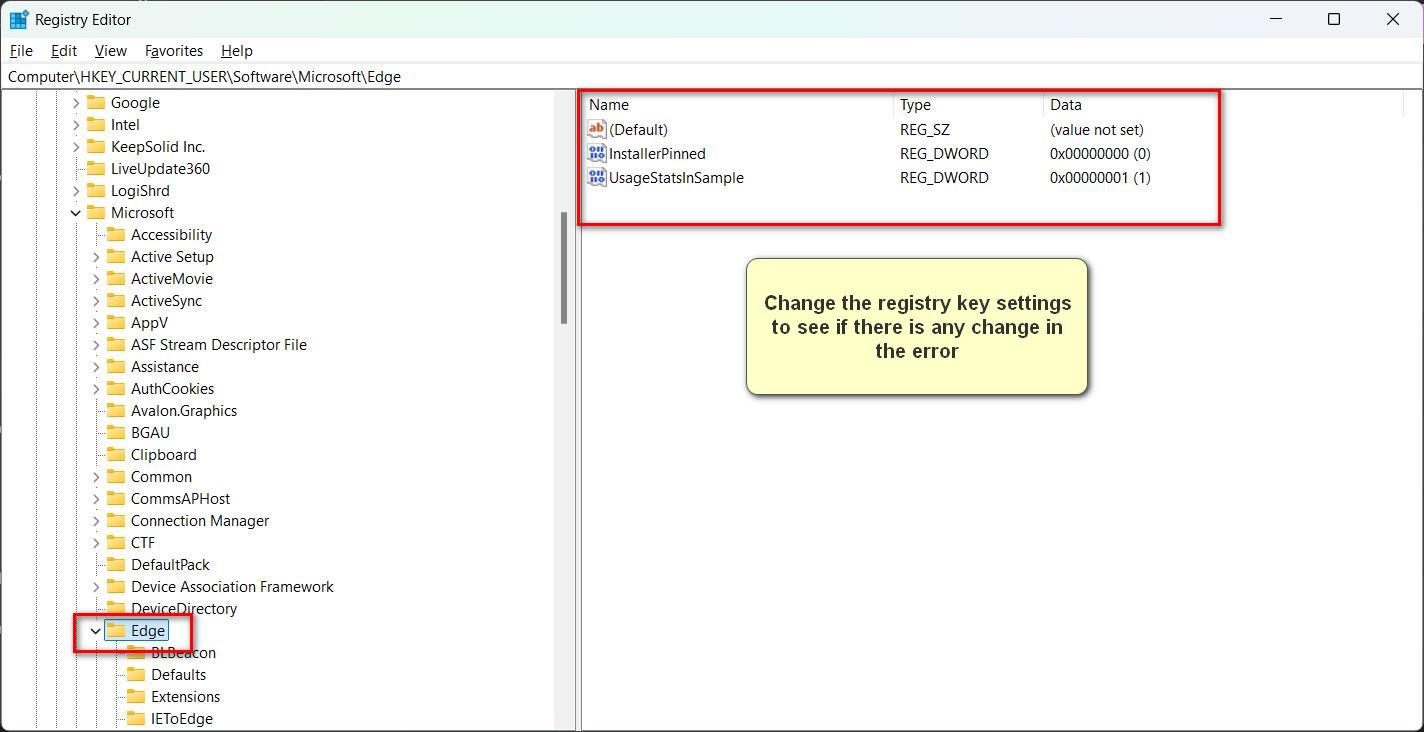
    Solution 4: Use Registry Editor to Remove Policies

    1. Press Windows + R, type regedit, and hit Enter.
    2. Navigate to HKEY_CURRENT_USER\Software\Microsoft\Edge.
    3. You can check relevant registry entries and add any if necessary.
    4. Delete unwanted keys affecting the browser. (Back up the registry first!)
    Solution 5: Scan for Malware or Unwanted Software

    1. Use Windows Defender or trusted antivirus software.
    2. Perform a full scan to detect any malicious software that could affect your browser.

    Solution: Remove Malware and Policies from Microsoft Edge (Windows 11 Home)

    Solution 6: Delete Registry Keys via Command Prompt

    Step 1: Remove Malware

    1. Use Microsoft Safety Scanner or another trusted antivirus tool.
    2. Perform a full system scan to ensure your system is clean.

    Step 2: Remove Edge Policies

    1. Close Edge completely:
    • Open Task Manager and end any remaining msedge.exe processes.
    1. Open Command Prompt as Administrator:
    • Right-click Start, select Run, type cmd, and press Ctrl + Shift + Enter.
    1. Delete Local User Policies:
    • Type: reg delete HKCU\SOFTWARE\Policies\Microsoft\Edge and press Enter.
    • Confirm successful operation.
    1. Delete Local Machine Policies:
    • Type: reg delete HKLM\SOFTWARE\Policies\Microsoft\Edge and press Enter.
    1. Restart Edge and System:
    • Close Command Prompt, restart your computer, and relaunch Edge to check if the issue is resolved.

    Sometimes the first command may not work, but you can continue with the second command. This worked on my Windows 11 Home edition. I was able to get the disabled settings back. Then I am able to control the Copilot feature settings.

    Solution 7: Disable Extensions and Add-ons

    1. Go to Edge settings > Extensions.
    2. Disable any unnecessary or suspicious extensions that might interfere with settings.

    Comments from Microsoft Forums

    • “After disconnecting my work account from ‘Access work or school,’ the message finally disappeared.” – Microsoft Community User
    • “A quick reset of Edge worked for me, and I didn’t lose any essential data.” – Tech Enthusiast
    • “Modifying the registry fixed my issue but be careful—back up your system!” – Forum Member

    Conclusion

    In conclusion, encountering the message “Your browser is managed by your organization” in Microsoft Edge is a common scenario for users on work or school devices, as it indicates that an IT administrator is controlling browser settings via Group Policy or MDM tools.

    This feature ensures compliance, enhances security, and streamlines browser management across organizations. However, if you see “Edge says managed by your organization” on a personal device, it may signal unintended policy enforcement.

    To address this, you can check your device’s policies or consult your IT department to determine the source of the management.

    For users looking to regain control, options like “remove Edge managed by your organization” involve reviewing and modifying registry settings or Group Policy configurations, though this should be done cautiously to avoid system conflicts.

    It’s also worth noting that certain features may display the message “This setting is turned off for managed browsers”, which means your organization has restricted access to specific configurations.

    By understanding the implications of managed browsers and taking informed steps, you can maintain a secure and personalized browsing experience while adhering to organizational requirements.

    Always prioritize consulting IT experts or official resources to ensure compliance and avoid unintended disruptions.

    For Windows 11 Home users, command prompt adjustments can be useful. Share other methods that worked for you in the comments below!

    Source: Why is Edge saying ‘Your browser is managed by your organization’? – Microsoft Community
  • 4 Simple Ways to Disable Copilot in Edge after 24H2 update

    4 Simple Ways to Disable Copilot in Edge after 24H2 update

    Microsoft Edge’s Copilot feature, powered by AI, offers users a range of intelligent tools to enhance productivity.

    However, not everyone finds it useful, and some may prefer to disable Copilot in Edge for reasons such as privacy concerns, reducing distractions, or optimizing system performance.

    If you’re looking to turn off Copilot in Edge, there are several methods to achieve this, depending on your technical expertise and requirements.

    For individual users, disabling the feature can be done directly through Edge’s settings. Advanced users or IT administrators can disable Copilot in Edge GPO (Group Policy Object) or modify the disable Copilot in Edge registry settings for broader control across multiple devices.

    These methods ensure that the feature is fully deactivated, whether you’re using Edge on a personal device or managing it in an enterprise environment.

    If you’re searching for ways to remove Copilot from Edge, this guide will walk you through step-by-step instructions, including how to désactiver Copilot Edge for French-speaking users.

    We have already discussed on how to disable copilot in Windows 11, and it works for the entire OS. Most of the times, the settings app comes to the rescue to uninstall, remove, disable any particular feature. In the same way, you can remove CoPilot from Edge for the system or user using different methods like registry, GPO and settings.

    I’ve updated the guide after the release of Windows 11 24H2 update. The screenshots are taken new.

    My initial problem was to remove CoPilot for Windows 11 Home! But as I see GPO doesn’t work for home edition. In that case, you can follow the steps in this guide, to disable this AI feature.

    How to Remove Copilot from Bing Search in Edge

    If you want to remove the Copilot AI from your Microsoft Edge browser, follow these simple steps:

    • Open Microsoft Edge on your PC.
    • Perform any search to load the Bing search results page.
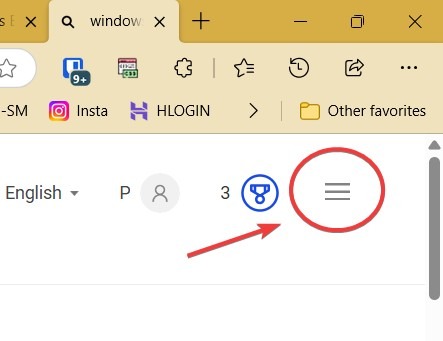
    • Click the three-line menu button located in the upper-right corner of the browser.
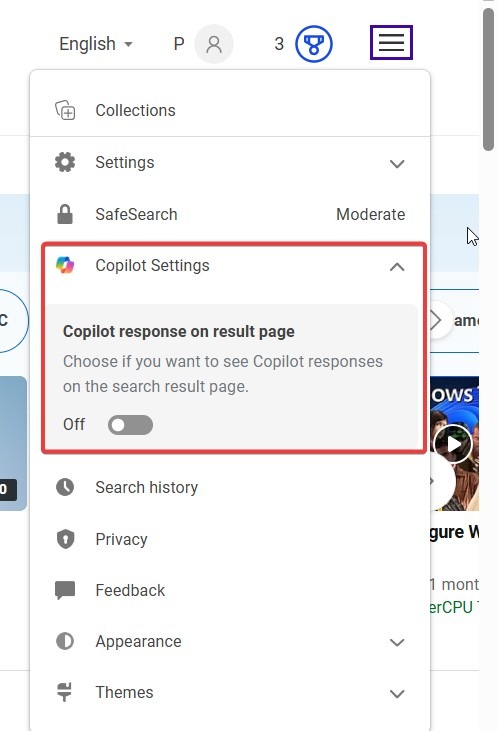
    • In the Copilot Settings section, toggle off “Copilot response on result page“.
    • Wait for the browser to refresh.
    • Click the three-line button again, and toggle off “Scroll to open Copilot” to prevent Copilot from automatically opening.
    • By following these steps, you can successfully remove the Copilot AI from your Edge browser and enjoy an uninterrupted browsing experience.

    How to Remove Copilot from Edge Using Registry Settings

    Microsoft’s Copilot AI has become a part of the Windows and Edge experience, but not everyone is happy with it. If you’re looking for a more permanent way to remove Copilot from Edge and Windows, modifying the registry is the most efficient method. In this guide, we’ll walk you through the necessary steps to disable Copilot in both Microsoft Edge and Windows using Registry Editor.

    Important: Editing the registry can have unintended consequences if done incorrectly. Always back up your registry before making any changes to avoid issues.


    Step 1: Open the Registry Editor

    To get started, press Win + R on your keyboard. This will bring up the Run dialog box. In the field, type regedit and press Enter. This will open the Windows Registry Editor.


    Step 2: Disable Windows Copilot for the Current User

    Navigate to the following path in the Registry Editor:

    HKEY_CURRENT_USER\Software\Policies\Microsoft\Windows\WindowsCopilot

    If the WindowsCopilot key doesn’t already exist, you’ll need to create it. Right-click the Windows folder, go to New > Key, and name it WindowsCopilot.

    Next, right-click inside the right pane, select New > DWORD (32-bit) Value, and name it TurnOffWindowsCopilot. Double-click it and set its value to 1. This will disable Copilot for the current user.


    Step 3: Disable Windows Copilot for All Users

    For a system-wide change, navigate to the following path:

    HKEY_LOCAL_MACHINE\SOFTWARE\Policies\Microsoft\Windows\WindowsCopilot

    Repeat the steps from before: create a new WindowsCopilot folder if it doesn’t exist, then create the TurnOffWindowsCopilot DWORD value and set it to 1. This will disable Copilot for all users on the machine.


    Step 4: Disable the Sidebar in Microsoft Edge

    Next, if you want to also remove the Copilot sidebar from Microsoft Edge, navigate to this path:

    HKEY_LOCAL_MACHINE\SOFTWARE\Policies\Microsoft\Edge

    Create or locate the HubsSidebarEnabled DWORD value. Double-click it and set its value to 0. This disables the sidebar, which includes Copilot functionality in Edge.


    Step 5: Disable Search Box Suggestions in Windows Explorer

    If you’re looking to further streamline your experience, you can disable search box suggestions in Windows Explorer. Navigate to:

    HKEY_CURRENT_USER\Software\Policies\Microsoft\Windows\Explorer

    Create the DisableSearchBoxSuggestions DWORD value and set it to 1.

    Repeat this process for all users by navigating to:

    HKEY_LOCAL_MACHINE\SOFTWARE\Policies\Microsoft\Windows\Explorer

    Create the same DisableSearchBoxSuggestions DWORD value and set it to 1 here as well.


    Step 6: Restart Your Computer

    After you’ve made these changes, restart your computer for them to take effect. Once your system restarts, Copilot and related features will be disabled, giving you a cleaner and more streamlined experience in both Windows and Edge.


    By following these registry tweaks, you can permanently remove Copilot from Microsoft Edge and Windows. This method ensures that Copilot won’t pop back up after updates, giving you more control over your browsing and desktop experience.

    How to Remove Copilot from Edge Using Local Group Policy Editor (GPO) in Windows 11

    Microsoft Edge’s Copilot AI may be helpful to some, but for many users, it’s an unwanted feature that clutters up the interface. If you’re using Windows 11 and want to remove Copilot from Edge, using Local Group Policy Editor (GPO) is one of the most efficient and permanent ways to disable it.

    This method is especially useful for IT administrators or users who want tighter control over their system without resorting to registry edits. In this guide, we’ll show you how to remove Copilot from Edge using GPO in Windows 11.


    What is Group Policy Editor?

    The Group Policy Editor is a Windows feature that allows you to control various system settings. It’s primarily used by IT administrators to manage multiple computers in a network, but it can also be used by individual users to customize system behavior. With GPO, you can disable certain features like Copilot in Microsoft Edge, ensuring they stay off even after updates.


    Step 1: Open Local Group Policy Editor

    To get started, follow these steps to access the Local Group Policy Editor:

    1. Press Win + R to open the Run dialog box.
    2. Type gpedit.msc and press Enter. This opens the Local Group Policy Editor.

    If you’re using Windows 11 Home edition, you may not have access to the Group Policy Editor by default. You can enable it manually or use other methods like registry edits.


    Step 2: Navigate to the Edge Policy Settings

    Once the Group Policy Editor is open, navigate to the relevant settings for Microsoft Edge:

    1. In the left pane, go to Computer Configuration.
    2. Expand Administrative Templates.
    3. Then, expand Microsoft Edge.

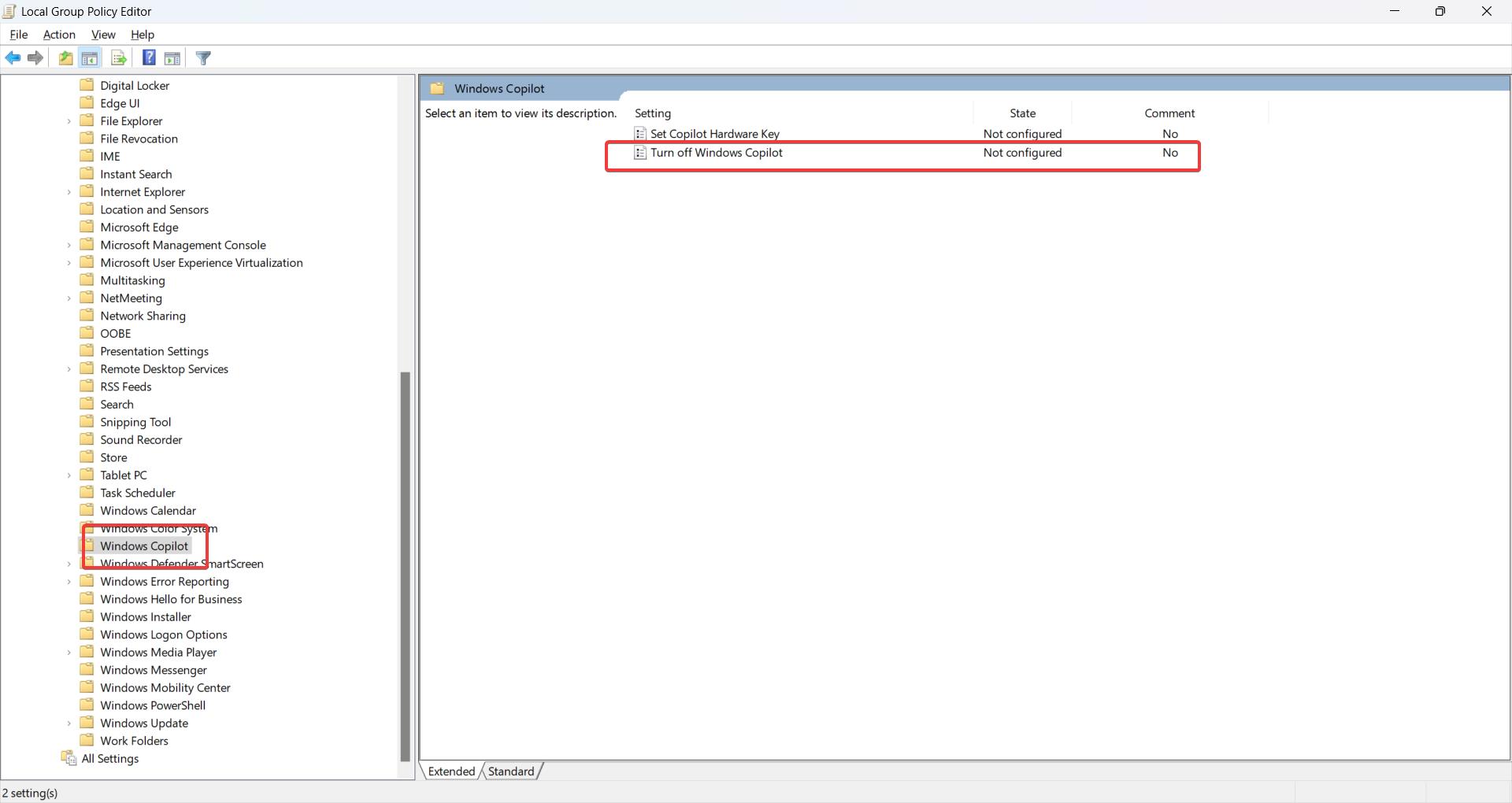
    Sometimes the above option may not be visible. In that case, you need to use the ADMX or ADML administrative templates related to Microsoft Edge from the official website. You should see the Windows Copilot setting to disable.

    Step 3: Disable Copilot in Microsoft Edge

    Now that you’ve navigated to the Microsoft Edge settings, you can proceed with disabling Copilot:

    1. Look for the policy setting labeled “Hubs Sidebar Enabled”.
    2. Double-click on this setting to open its configuration window.
    3. In the window that opens, select Disabled.
    4. Click Apply, and then click OK.

    This will disable the sidebar in Microsoft Edge, which includes the Copilot feature.


    Step 4: Apply the Changes

    To ensure that the changes take effect, run the following steps:

    1. Open Command Prompt as an administrator. (You can do this by searching for “cmd” in the Start menu, then right-clicking and selecting Run as administrator.)
    2. Type the following command:
       gpupdate /force
    1. Press Enter. This command forces the Group Policy updates to apply immediately.

    Step 5: Restart Your Computer

    After applying the changes using Group Policy, restart your computer to ensure that Copilot is fully disabled in Microsoft Edge.


    Why Use Group Policy to Remove Copilot?

    Using Group Policy to remove Copilot from Edge has several advantages:

    • Permanent Solution: Unlike some browser-based settings that may revert after updates, Group Policy changes are more permanent.
    • System-Wide Control: This method disables Copilot for all users on the system, making it ideal for multi-user setups or IT-managed environments.
    • No Registry Editing: For users who prefer not to edit the Windows Registry, Group Policy offers a safer and more user-friendly option.

    What Is Microsoft Edge Copilot?

    Alright, so before we go any further, let me tell you what Copilot is—just in case you’re scratching your head, wondering why it’s even there.

    Copilot is Microsoft’s AI assistant that sits in your browser, ready to help with searches, tasks, suggestions, and even answering questions.

    It’s kinda like Clippy from the old days, but with AI powers. Honestly, it sounds cool in theory, but in practice, I never found myself using it.

    I remember the first time it popped up. I was just trying to search for something simple, and Copilot jumped in with a suggestion. Instead of helping, it threw me off my usual flow.

    I guess some people might appreciate the help, but for me, it was just annoying. It’s like that one overly helpful coworker who’s always offering advice when you didn’t ask for it. So, if you’re not vibing with Copilot sitting in your sidebar, I totally get it!


    Why You Might Want to Remove Copilot from Edge:

    Now, why would you want to remove Copilot? Oh, let me count the reasons! First off: privacy. I’m not a fan of the idea of an AI assistant lurking around my browser, collecting who knows what data.

    Even though Microsoft claims it’s all secure, I still feel uneasy. I mean, who really knows what’s going on behind the scenes, right? It’s like having someone read over your shoulder while you browse. No thanks.

    Also, I noticed that after the update, my browser felt… sluggish. I’m not saying Copilot’s the only culprit, but after I disabled it, Edge definitely seemed to speed up.

    And then there’s the clutter factor. I hate clutter and having that AI sitting in the sidebar was like having a permanent sticky note on my screen that I couldn’t remove.

    If you’re like me and prefer simplicity, getting rid of Copilot can really streamline things. Plus, it’s one less distraction when you’re trying to get stuff done.


    How to Disable Copilot in Microsoft Edge

    Step 1: Open up Microsoft Edge.

    Anyway, open Edge and head to the top-right corner where there’s that little three-dot menu. Click on it and scroll down to Settings.

    Step 2: Copilot tab

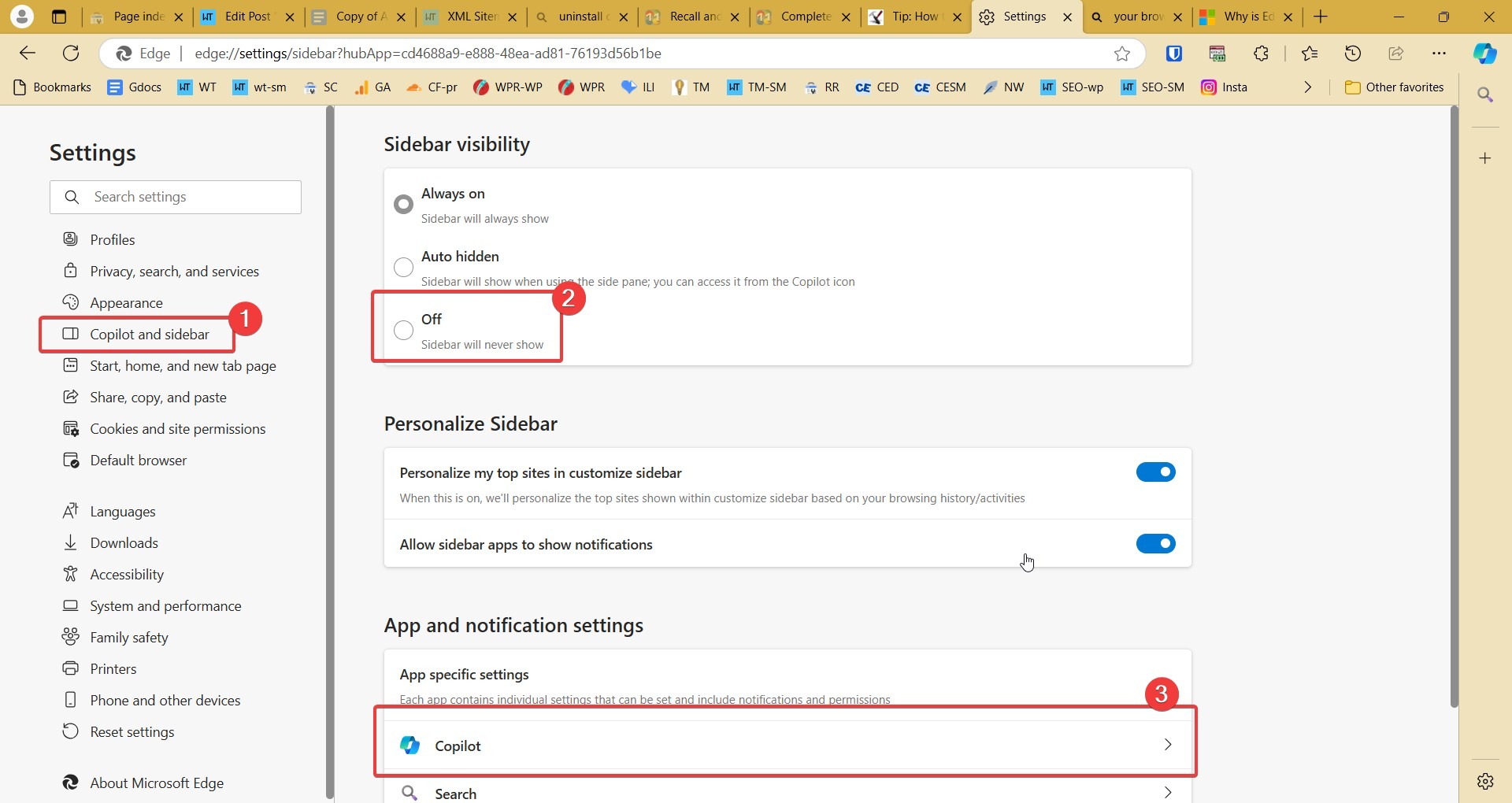
    Once you’re in settings, look for the Copilot and sidebar tab on the left-hand side.

    Step 3: Turn off Sidebar

    In the Sidebar visibility section on the right-hand side, you should see an option for the “Off”. This will turn off the sidebar completely. But if you would like to disable only CoPilot, go to App and Notification Settings.

    Step 4: Disable Copilot in Edge

    Click the arrow against it. Now turn off the option. Show Copilot. This should disable the AI feature. You can enable it again if required.

    You can also use the command Ctrl + Shift + . on your Windows 11 computer to open Copilot. You can see the gear icon at the bottom. It will directly take to Step 3.


    How to Remove the Copilot Sidebar in Windows 11

    If you’re on Windows 11, the process is a little different—but don’t worry, it’s not rocket science. So I was on my PC one day, thinking I’d already gotten rid of Copilot, but nope—it was still hanging out in the sidebar. Turns out, Windows 11 has its own settings you need to tweak.

    Step 1: Open Edge again (ugh, I know), and head to the Sidebar settings. This was an extra step I didn’t realize was necessary until I did some digging around forums. It’s like Copilot was hiding in plain sight.

    Step 2: You’ll see the Copilot toggle here too. Make sure it’s switched off. But, again, you’re not done.

    Step 3: Go to your Windows 11 settings and look for the Taskbar settings. There’s an option here to remove the sidebar entirely. I didn’t realize at first that Edge’s sidebar was connected to the Windows sidebar. It’s like they’re in cahoots! Disable it here, and you’ll finally be free of Copilot.


    Customizing Microsoft Edge for a Better Browsing Experience

    After you’ve kicked Copilot to the curb, let’s talk about making Edge your browser again. One thing I love about Edge is how customizable it is, once you get past the AI stuff. With Copilot gone, you’ve got more space to tweak things to your liking.

    First, I recommend customizing your start page. Personally, I hate when browsers open with a bunch of unnecessary junk, so I set mine to open on a blank page. You can also switch up your default search engine. Bing’s okay, but if you’re like me and prefer Google, this is the time to make the change.

    Don’t forget to check your privacy settings while you’re at it. With AI assistants like Copilot gone, it’s a good idea to double-check how your data’s being stored. Microsoft has a lot of built-in tracking stuff that you can turn off if you dig deep enough. It’s not exactly advertised, but once you know where to look, you can lock things down pretty tight.

    Conclusion

    Microsoft Edge’s Copilot feature, integrated with AI, is designed to assist users with tasks like searching, writing, and summarizing content.

    However, some users may prefer to disable Copilot in Edge due to privacy preferences, performance optimization, or simply to declutter their browsing experience.

    Whether you’re an individual user or an IT administrator, there are multiple ways to turn off Copilot in Edge effectively.

    For personal use, you can disable Copilot in Edge directly through the browser’s settings. For enterprise environments, administrators can use disable Edge Copilot GPO (Group Policy Object) or modify the disable Edge sidebar registry to enforce these changes across multiple devices.

    If you’re wondering how to remove Copilot from Edge, this guide provides clear, step-by-step instructions tailored to your needs.

    Additionally, users on Windows 10 or 11 can explore options like deactivate Copilot Windows 10 or disable Copilot Windows 11 GPO for a more comprehensive approach.

    By following these methods, you can customize your Edge experience, ensuring it aligns with your workflow and preferences. Whether you’re looking to supprimer Copilot Edge (remove Copilot in French) or simply disable Edge Copilot, this guide ensures a seamless and authoritative solution.

  • 7 Key Tips to Select the Best Laptop

    7 Key Tips to Select the Best Laptop

    Looking for laptop selection tips on what to keep in mind when buying a new laptop? With so many options and technologies to consider, selecting the perfect laptop that meets your needs can be challenging.

    This article provides laptop buying considerations, laptop purchase guidelines, as well as a technical laptop specification guide to help you make the best choice.

    Firstly, consider what you primarily intend to use the laptop for: tasks like web browsing, office work, gaming, graphic design, video editing or programming.

    Your main usage scenario should dictate priorities regarding laptop criteria like CPU power, RAM, GPU, storage space or display resolution.

    Next, here are key factors to evaluate when picking out ideal laptop qualities:

    CPU (Central Processing Unit)

    The CPU handles the actual computing, calculations and processing of tasks. Core aspects are:

    • Brand: Popular options – Intel Core i3, i5, i7, i9 or AMD Ryzen 3, 5, 7, 9. Higher series number indicates better performance.
    • Speed (GHz): Faster clock speed → better multitasking and computing power. Avoid less than 1.5 GHz for optimum performance.
    • Cores/Threads: More cores/threads allows parallel processing, especially useful for intensive tasks like video editing, graphics work, programming etc.

    Good CPU examples – Intel Core i7-8565U (Quad core, 1.80 GHz, for ultrabooks and general use) or AMD Ryzen 9 5900HS (Octa core, 3.0 GHz, for gaming laptops and workstations).

    RAM (Memory)

    RAM enables quicker access to open apps and files. Things to note:

    • Type – DDR4 is the latest standard. Speed of at least 2666 MHz is suggested.
    • Size: 8 GB RAM is minimum. Go for 16GB+ RAM for gaming or media editing needs.

    Some laptops allow further RAM upgrades/customization. Overall, more RAM improves performance when multitasking.

    Storage

    Essential for installing the operating system, applications, files. Key factors:

    • HDD (Hard Disk Drive) – Cheaper, more storage (up to 2 TB). Useful for secondary storage needs.
    • SSD (Solid State Drive) – Expensive, less storage, but MUCH faster read/write speeds and better performance especially for bootup/loading apps/games. Popular only storage option for most laptops now.
    • Combination – Some laptops provide both 128/256/512 SSD for boot + high speeds + 1 TB HDD for more storage. Great for performance as well as large storage needs.

    GPU (Graphics Processing Unit)

    Dedicated GPUs are designed for gaming, video editing and graphical applications. Aspects to consider:

    • Type – Options like NVIDIA GeForce or AMD Radeon. NVIDIA RTX 3000 series and AMD RX 6000 series are latest integrated GPUs offering advanced capabilities.
    • RAM – More VRAM (video RAM) enables handling better graphics and higher resolutions. Minimum 4 GB GPU RAM recommended.

    Gaming/media creative laptops should have powerful GPU options like NVIDIA RTX 3050ti, 3060 or AMD Radeon RX 6600M or better.

    Display Panel

    As you stare at it continually, the display panel is an integral element influencing overall laptop usability. Components to evaluate in display performance:

    Resolution – The sharpness of the visuals. 1080p Full HD (1920 x 1080 pixels) is standard. 1440p (2560 x 1440p) or 4K (3840 x 2160) offered on higher-end laptop displays. Gamers may prefer 1080p with a high refresh rate (144Hz) panel.

    Size – Typical options range from 11 to 17 inches. Choose based on your portability needs versus immersive experience.

    Panel Technology – Progressing from standard to best viewing experience –> TN/IPS/OLED/Mini-LED panels.

    Connectivity Ports

    Physical ports are required to connect external devices like mouse, storage drives etc. Do choose a laptop with:

    • Multiple USB Type A and/or Type C ports
    • HDMI for secondary displays
    • Headphone jack (3.5mm)
    • Inbuilt or external webcam, mic
    • Card reader for camera memory cards (for media editing)

    Having more available ports or ability to extend ports through a dock provides superior long term connectivity and convincing perfect laptop attributes.

    Wireless Connectivity

    A key ideal laptop quality is excellent wireless connectivity enabling mobility/portability:

    WiFi – Support for latest 802.11ax WiFi 6/6E standards offer fastest wireless internet speeds and low latency connectivity with compatible routers. Great for office work, streaming or gaming needs.

    Bluetooth – Bluetooth v5.1 or above provides fast connectivity and minimal lag with paired wireless headphones, mice or other compatible accessories and IoT devices.

    SIM Slots – Integrated 4G or even 5G SIM card slots for internet connectivity is now available on certain premium laptop models. Super useful when travelling without accessible WiFi networks.

    Choosing the right specifications based on intended usage along with nice-to-have laptop features like long battery life, large precision trackpad, comfortable backlit keyboard etc sets you on the path to selecting the ideal laptop as your daily driver device for work and play!

    Some examples of well-rounded laptops with excellent combo of above traits are:

    Popular laptop models with key specifications:

    General/Everyday Use Laptop

    Dell XPS 13 (9310)

    • CPU: 11th Gen Intel Core i7-1185G7
    • RAM: 16GB LPDDR4X
    • Storage: 512GB M.2 PCIe NVMe SSD
    • Graphics: Intel Iris Xe
    • Display: 13.4″ FHD+ (1920 x 1200) InfinityEdge Touch
    • Ports: 2x Thunderbolt 4, MicroSD card reader, Headphone jack

    Gaming Laptop

    ASUS ROG Zephyrus G15

    • CPU: AMD Ryzen 9 5900HS
    • RAM: 16GB DDR4 3200MHz
    • Storage: 1TB PCIe NVMe M.2 SSD
    • Graphics: NVIDIA GeForce RTX 3070 Laptop GPU 8GB GDDR6 with ROG Boost
    • Display: 15.6” QHD (1440p) 165Hz 3ms
    • Ports: 1x USB 3.2 Gen 2 Type-C support DisplayPort / power delivery / G-SYNC, 2x USB 3.2 Gen 1 Type-A, HDMI 2.0b, 3.5mm Combo Audio Jack

    Content Creation/Video Editing Laptop

    Apple MacBook Pro 16″

    • CPU: Apple M1 Pro chip (10-core CPU)
    • RAM: 32GB unified memory
    • Storage: 1TB SSD storage
    • Graphics: 16-core GPU
    • Display: 16.2″ 3456 x 2234 backlit mini-LED Liquid Retina XDR display
    • Ports: 3x Thunderbolt 4 / USB4 ports, HDMI port, SDXC card slot, MagSafe 3 port

    I hope these laptop purchase guidelines help you zero in on your target laptop with necessary performance criteria whilst also keeping budget constraints in mind during your buying decision process.

    Let me know if you have any other specific queries regarding the ideal specs for choosing the perfect laptop to suit your needs!

  • RAM of Laptop – 5 Quick Easy Steps to Know amount and Type

    RAM of Laptop – 5 Quick Easy Steps to Know amount and Type

    Wondering what RAM of laptop is or how to check the RAM configuration? RAM (Random Access Memory) is an important component that impacts your laptop’s performance.

    Having sufficient RAM allows your laptop to run multiple programs efficiently by providing quick access to data. In this blog post, we will discuss the different types of laptop RAM, how to check your laptop’s RAM, and provide an overview of the latest RAM options for laptops in 2023.

    How to Know Amount of RAM in Laptop

    The first step to understanding your laptop’s RAM configuration is to check the DDR or Double Data Rate type. DDR refers to how many times per second the RAM can read and write data. Common DDR types found in laptops include:

    • DDR3 – An older type of RAM that allows up to 8 data transfers per second. DDR3 RAM has been used in laptops since 2007.
    • DDR4 – The most widely used type currently, allowing up to 16 data transfers per second. Improves performance over DDR3.
    • DDR5 – The newest RAM specification released in 2020, allowing up to 32 data transfers per second. DDR5 is the fastest type but is only found in newer high-end laptops.

    To check if your Windows laptop has DDR3, DDR4 or DDR5 RAM:

    • Go to the Start menu and search for “Task Manager”
    • Click on the Performance tab
    • Check the section labeled “Memory” – it will show the DDR type next to the word “Speed”

    Knowing the DDR type will give you an idea of your laptop’s RAM speed and performance capabilities.

    How Many Types of RAM in Laptop

    Laptop RAM comes in different physical types or form factors. The common RAM types are:

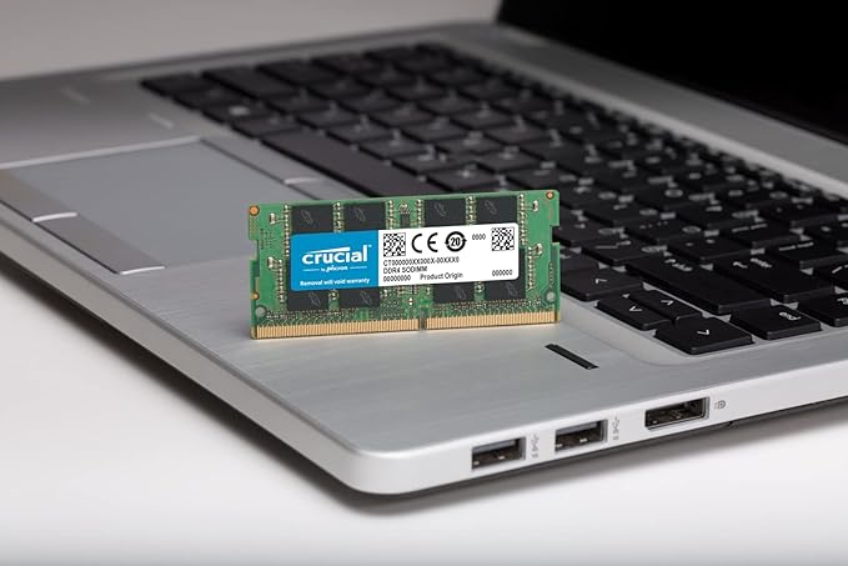
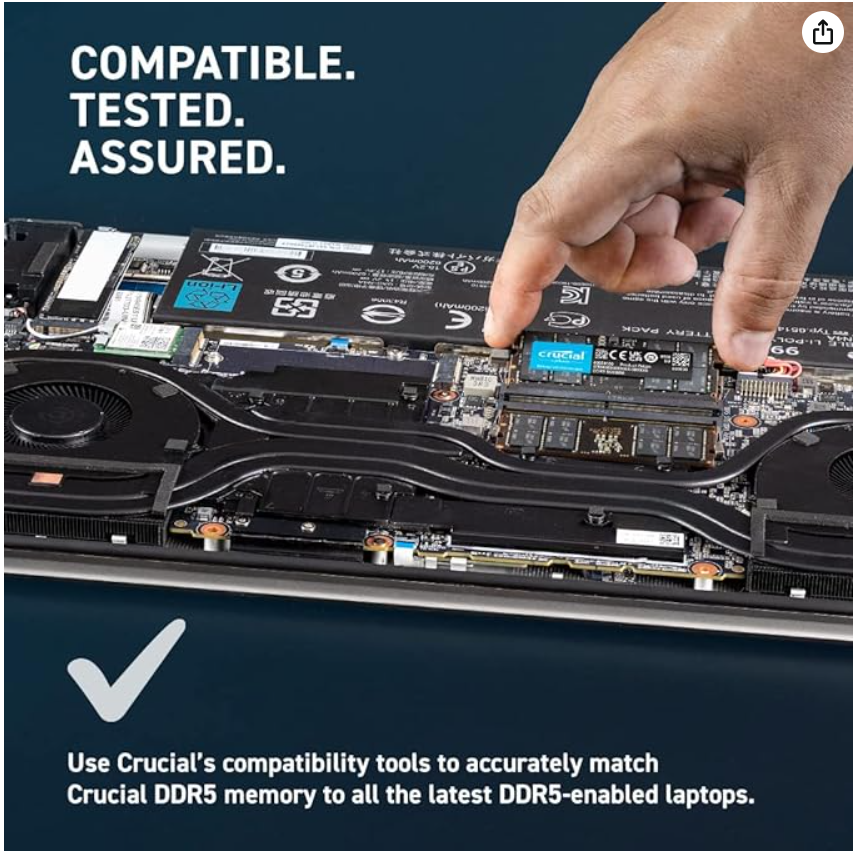
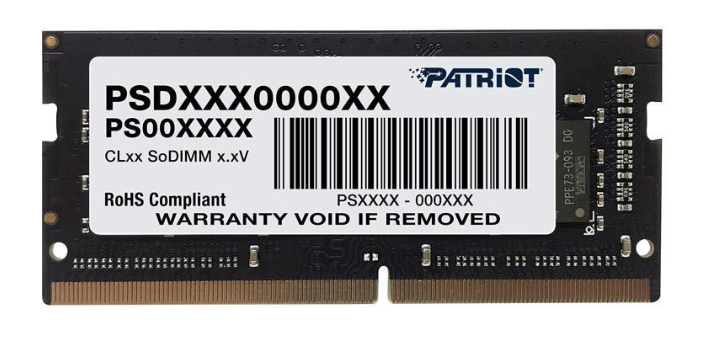
    • SO-DIMMs – The smaller, denser RAM sticks made specifically for laptops and small devices. SO-DIMM stands for Small Outline Dual In-line Memory Module.
    • SODIMMs DDR4 – The latest SO-DIMM type that supports DDR4 RAM for faster data transfer speeds. This is the most widely used laptop RAM today.
    • SODIMMs DDR5 – An emerging SO-DIMM format for DDR5 RAM. Provides ultra-fast data transfer but is currently only found in high-end laptops.

    Laptops require the use of specialized SO-DIMM RAM sticks to fit into the smaller slots. Knowing if you need DDR4 or DDR5 SO-DIMMs is important for upgrading or replacing your laptop RAM.

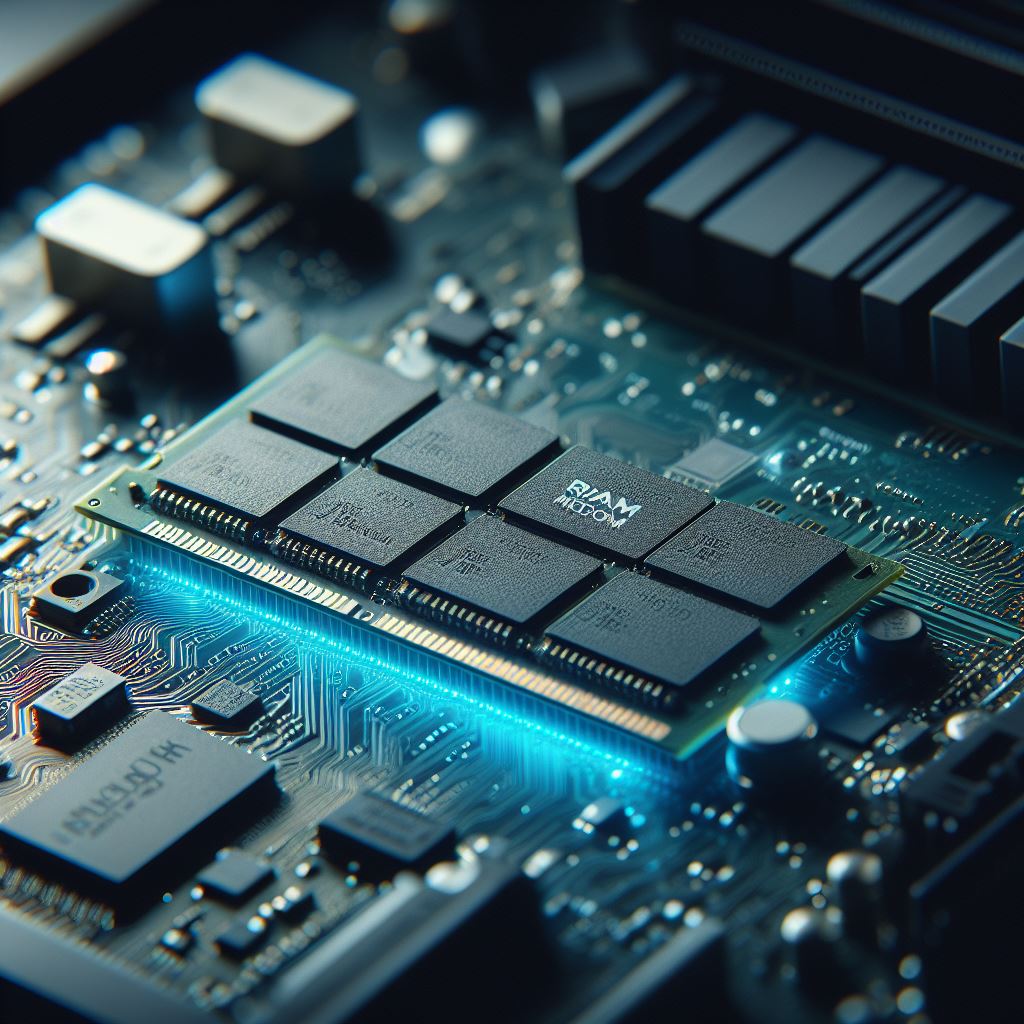
    ram for laptop ddr5

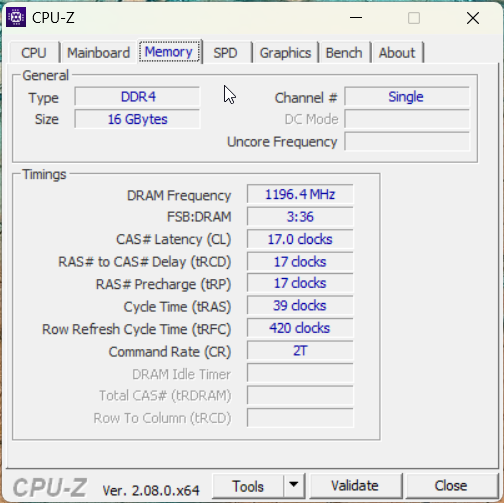
    How to Check RAM Type on a Laptop using CPU-Z

    CPU-Z is a free system information tool that provides detailed specs of your computer hardware including RAM details.

    Install and Open CPU-Z

    1. Go to https://www.cpuid.com/softwares/cpu-z.php and download the latest version of CPU-Z.
    2. Double click on the .exe file and install CPU-Z on your Windows laptop.
    3. Open the CPU-Z app after installation.

    Check RAM Details

    1. In the CPU-Z window, go to the “Memory” tab.
    2. Under the section SPD, you can view manufacturer, type, frequency and timings details of RAM stick 1 and stick 2.
    3. The type will clearly show whether your laptop’s RAM is DDR4 or DDR5.
    4. You can also see further technical specifications of your RAM configuration in CPU-Z like voltage, data width etc.

    That’s it! With CPU-Z you can easily find out if your laptop is running DDR4 or latest gen DDR5 memory in a few simple clicks. CPU-Z offers much more detailed RAM information compared to Task Manager.

    Which Type of RAM is Used Exclusively in Laptops

    As mentioned above, the SO-DIMM form factor RAM is made exclusively for use in laptops and small devices. SO-DIMM sticks are about half the size of desktop RAM sticks.

    The main benefits of SO-DIMMs are:

    • Small size – Allows more RAM capacity in the limited space of laptop motherboards.
    • Low power draw – SO-DIMM RAM uses less voltage to stay within laptop power budgets.
    • Efficient design – Provides notches, connectors, and pins specifically engineered for mobile devices.

    For these reasons, laptops will always use SO-DIMMs over the larger DIMMs found in desktop PCs. Both DDR4 and DDR5 RAM types come in SO-DIMM variants to meet exclusive laptop compatibility.

    Latest RAM of Laptop of 2023

    DDR5 RAM is the latest RAM specification that is gaining adoption in new laptop models for 2023. Key features of DDR5 laptop RAM include:

    • Faster clock speeds – Starts at 4800MHz speed, almost double that of DDR4 which maxes out around 3200MHz. Enables better laptop performance.
    • Higher capacities – DDR5 goes up to 64GB per RAM stick allowing more memory in laptops.
    • Lower voltage – Operates at just 1.1v vs 1.2v for DDR4. Results in battery life savings.
    • On-board error correction – DDR5 chips have additional memory circuits to monitor and fix data errors. Improves stability.

    Top laptop brands like Dell, HP and Lenovo are releasing premium consumer and business laptops with DDR5 RAM options. As manufacturing scales up, DDR5 will be more affordable and become the mainstream choice moving forward.

    ram for laptop ddr

    Types of RAM in 2023 for Laptop

    To summarize, here are the types of laptop RAM that will be widely used going into 2023:

    • DDR4 SO-DIMMs – The current standard for laptop memory. DDR4 SO-DIMMs provide a cost-effective performance boost over older DDR3 RAM. They are available in frequencies up to 3200MHz and capacities up to 64GB per stick.
    • DDR5 SO-DIMMs – The latest generation packed with new features. DDR5 SO-DIMM capacities go up to 64GB at speeds starting from 4800MHz. Ideal for professional creators and gamers.
    • LPDDR4X – A variant of DDR4 used in ultra-thin and light laptops focused on portability. LPDDR4X has reduced power demands, allowing smaller batteries to power sleek designs. Available up to 64GB also.
    • LPDDR5 – Next-gen low power RAM for thin and light systems. Launching in 2023 laptop models with properties of both DDR5 and LPDDR4X. Enables faster yet efficient performance.

    DDR4 currently offers the best balance of price and performance for most laptop users shopping in 2023. However DDR5 SO-DIMMs are the new premium option available for those wanting cutting-edge speeds. Consider your usage needs and laptop model compatibility when deciding on your next RAM upgrade!

  • Top 10 Best Laptop for Students (After Research)

    Top 10 Best Laptop for Students (After Research)

    Getting through school nowadays requires a trusty laptop by your side. Whether you’re working on papers, creating presentations, collaborating with classmates, joining online lectures, or just taking notes, having the right laptop makes all the difference.

    The best laptops for students offer a balance of portability, power, battery life and features – while also fitting within a student budget.

    As we head into 2024, here is an in-depth look at the best laptop options for high school, college and university students:

    Best Laptop for High School Students

    High school places demands on students unlike earlier grades. You juggle advanced coursework, extracurriculars, college prep and a social life. Having a reliable laptop helps you power through busy school days and nights without disruption.

    When searching for the best laptop for high school students, keep these factors in mind:

    • Weight – Since high school students haul their laptops around all day from class to class, cafeteria, library and home, an ultraportable is ideal. Look for less than 4 pounds.
    • Battery life – A battery that lasts 6+ hours allows you to make it through a full day of classes without having to scramble for an outlet between periods.
    • Responsiveness – Quick boot up and load times help you start working without delay whenever inspiration strikes. Prioritize laptops with SSD drives and solid state memory.
    • Durability – Accidents happen when you’re rushing between activities. Find a laptop made of strong materials that can handle some bumps and drops along the way.
    • Good keyboard – You likely have lots of papers and online assignments to type up. Make sure the keyboard offers a comfortable, responsive typing experience.

    Taking these factors into account, here are two fantastic options that earn top marks as the best high school laptop for students in 2024:

    Apple MacBook Air (M2 Chip, 2022)

    The recently updated MacBook Air with Apple’s blazing fast new M2 chip sits at the top of the class for a high school laptop this year.

    Weighing just 2.7 pounds with an ultra-slim design, the MacBook Air won’t weigh down your backpack as you move between your locker, classrooms and extracurriculars. It also promises all-day battery life up to 18 hours, so you can keep your work and entertainment going even during the busiest days.

    The new M2 chip makes the MacBook Air faster than ever. It boots up and jumps between tasks incredibly quickly thanks to the 8-core CPU. The 8-core GPU also brings a boost to graphics performance. This responsiveness will come in handy whether you’re researching a term paper, streaming videos for a presentation or messaging classmates about an upcoming group project.

    While matching the portability of previous models, the 2022 MacBook Air steps up durability by adding the updated MagSafe magnetic power adapter. This magnetic attachment protects your laptop if someone trips over the charging cable. Apple also made the display 20% larger while keeping a very portable form factor.

    With the excellent MacOS operating system and access to all the Apple apps, the 2022 MacBook Air brings simplicity plus seamless iPhone and iPad integration. Add in the best-in-class trackpad and keyboard for breezing through assignments, and the MacBook Air is a standout choice for ambitious high school students.

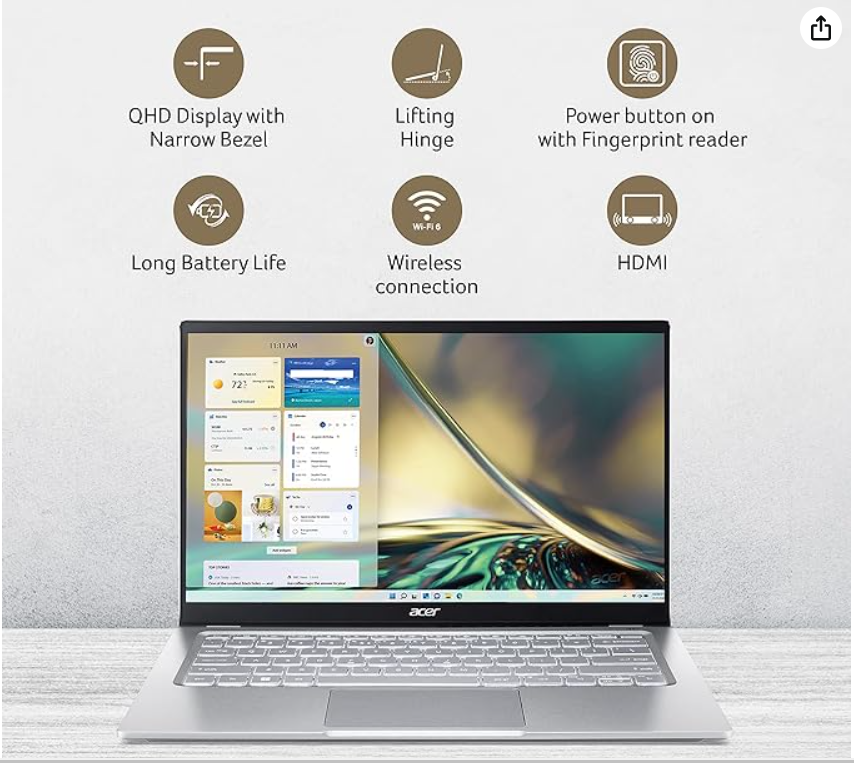
    Acer Swift 3 Thin & Light Laptop

    If you want a Windows laptop alternative that’s suited for high school without the premium Apple price tag, look no further than the Acer Swift 3. This lightweight clamshell laptop weighs just 2.65 pounds for easy portability around campus.

    Acer packs long battery life into the Swift 3 that lasts up to 17 hours per charge. It also features fast Wi-Fi 6 connectivity and multiple ports like USB-C, USB 3.2 Gen 1 and HDMI that keep you connected.

    Every high school student needs responsiveness when working on multiple assignments and shifting between homework, hobbies and socializing. The Swift 3 delivers with the latest 12th Generation Intel Core i7 processor and Intel Iris Xe graphics. Quick start-up, fast load times, smooth interface animation and great multitasking capabilities make this Acer Swift 3 perfect for high schoolers always on the go.

    Think you might accidentally drop your laptop amidst the high school hustle? No worries with the durable aluminum chassis on this laptop that withstands bumps, scrapes and drops. Acer also constructed a reliable keyboard that allows for comfortable typing to finish all your papers and online assignments.

    Overall, the Acer Swift 3 checks all the boxes of an ideal laptop for high school that’s portable, fast, long-lasting and able to keep up with busy student life.

    Best Budget Laptop for Casual Students

    College students have enough financial burdens to deal with just paying for tuition, housing, books and other expenses. Finding an affordable yet capable laptop helps ease the monetary strain. When you’re shopping for the best budget laptop for college students or those headed to university, prioritize the following:

    • Processing power – College coursework and multimedia projects require substantial processing capabilities for optimal performance
    • Storage – A 128-256GB SSD allows you to store all required apps, notes, assignments and other documents
    • RAM – Look for 8GB RAM at a minimum to efficiently multitask programs and browser tabs
    • Display – Pick a screen 11″ up to 15″ that clearly displays text, images and videos without eyestrain
    • Battery life – 5+ hours of use lets you complete assignments around campus away from the charger
    • Weight – Under 3 pounds if carrying the laptop to/from classes over substantial distances

    While you’ll still get premium features with budget options, you’ll likely have to accept some plastic casing instead of metal. But the performance can still compete with far more expensive devices.

    After comparing all options on the market right now, two affordable Windows laptop models stand out:

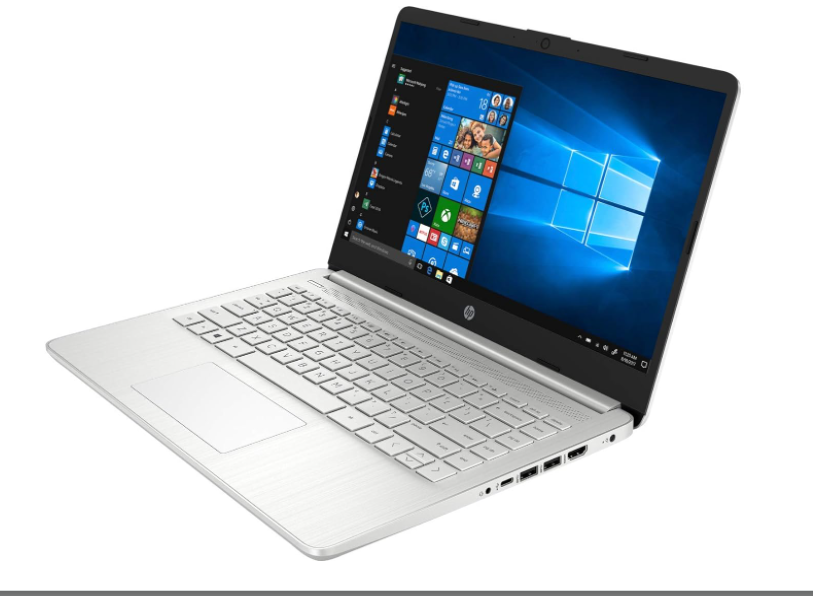
    HP 14″ Laptop

    This multipurpose HP 14″ laptop costs several hundreds dollars less than premium options while still packing substantial power. Part of HP’s budget line focused on core performance for everyday users, it handles all the tasks high school and college students need to zoom through busy school days.

    Some of the most impressive features packed into this budget-friendly laptop include:

    • 11th Generation Intel Core i5 processor
    • Intel UHD integrated graphics
    • 8 GB RAM
    • Fast 256 GB SSD storage
    • 14-inch 1080p display with stunning image quality
    • Audio by B&O for crisp sound
    • HD camera with wider field of view for online classes
    • Wi-Fi 5 connectivity

    Weighing 3.24 pounds, it offers desktop-class performance when traveling around campus or working from your dorm room desk. The battery lasts around 8 hours when away from an outlet.

    If portability matters most, it’s hard to beat the HP 14″ price-to-performance ratio that still packs substantial power.

    hp best laptop for students

    Lenovo IdeaPad 3

    Another Windows laptop with premium features at a student budget cost comes from Lenovo. The IdeaPad series focuses on portability plus performance at an affordable price point.

    The Lenovo IdeaPad 3 nails the basics for students needing reliable tech by including:

    • 12th Gen Intel Core i3 processor
    • Intel UHD graphics
    • 8GB DDR4 RAM
    • 128GB SSD storage
    • 14-inch FHD display
    • 720p webcam with privacy shutter
    • Dolby Audio speakers
    • Up to 8 hours battery life

    Weighing 3.3 pounds, this 14-inch Lenovo IdeaPad offers desktop-level performance in a portable package students can easily transport in backpacks and bags around campus for long days of learning and group work.

    Between the i3 processor, SSD storage, 8GB RAM and FHD display packing nearly 2 million pixels, it delivers reliable speed and performance for research projects, papers, graphic design work, coding applications, online classes and more without delays.

    Ultimately, Lenovo designed this affordable IdeaPad with non-stop productivity in mind. Students will appreciate just how much computing power Lenovo packed in for hundreds less than premium options.

    Best Laptop for College Students Under $500

    Most college students need to stick to a laptop budget under $500. Luckily, many respectable options exist in 2023 without sacrificing tons of performance, display quality and portability college demands.

    Here is what to prioritize when seeking out the best laptop for college students under $500:

    • Processing power – Look for at least 11th Gen Intel Core i3 or equivalent AMD Ryzen 3 processor
    • RAM – Find a laptop with 8GB RAM minimum to comfortably run multiple programs simultaneously
    • Storage – 256GB serves as the minimum SSD storage for apps, files and media
    • Display – Focus on at least Full HD (1920 x 1080p) resolution and avoid less than 14 inches
    • Battery life – Try to get at least 6 hours away from an outlet
    • Weight – Remain under 3.5 pounds for easy transport across campus
    • Bonus features – Webcam, Wi-Fi 6, Bluetooth 5.1, USB ports

    Balancing all these factors with a $500 budget proves challenging. But two laptops giving premium brands a run impress with well-rounded capabilities college students need:

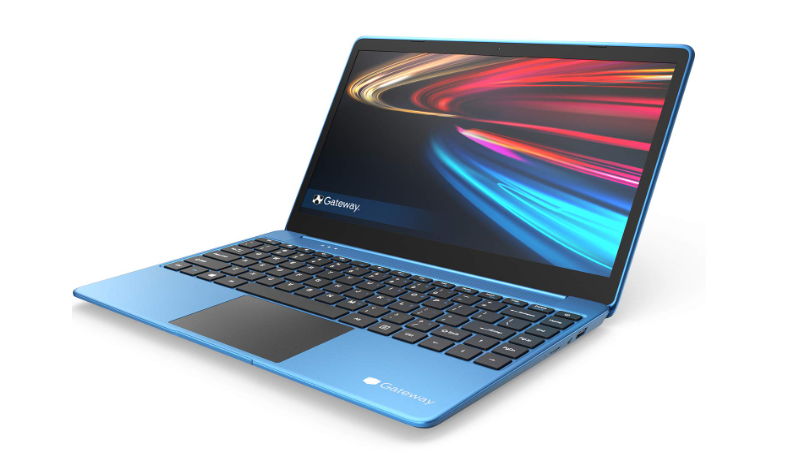
    Gateway Ultra Slim Notebook

    This slim black notebook from Gateway measures just 0.78 inches thin and weighs 3.64 pounds but still promises a full computing experience.

    It comes configured with respectable internals including an:

    • 11th Gen Intel Core i3 processor
    • Integrated Intel UHD graphics
    • 8GB of RAM
    • 128GB SSD

    College students will appreciate the 14-inch Full HD 1080p display packing high-color accuracy at over 45% NTSC. The narrow bezels give a screen-to-body ratio over 82% so the display fills more notebook real estate.

    Battery life lasts around 8.5 hours for full days on-the-go. It also comes with an HD webcam, fingerprint reader for quick secure logins, and USB 3.1 Type C port alongside USB 3.1 Gen 1 and HDMI input.

    Overall for under $500, this Gateway Ultra Slim Notebook gives premium styling, respectable performance and over 8 hours of battery in an ultraportable package.

    ASUS VivoBook 15 Thin and Light Laptop

    If you want even more performance at less than $500 tailored for college students, consider the ASUS VivoBook 15.

    It bumps up processing power through the:

    • AMD Ryzen 5 5500U Processor
    • AMD Radeon Graphics
    • 8 GB DDR4 RAM
    • 256GB SSD storage

    This hardware combo makes the VivoBook 15 snappier at loading apps, playing videos, surfing Chrome with multiple tabs open and breezing through design projects.

    The 15.6-inch Full HD four side narrow bezel display creates an immersive viewing experience with sharper visuals. This makes watching lecture recordings, following along presentations and editing photos much easier on the eyes.

    Rounding out the complete package, ASUS extended the battery life to last over 6 hours per charge. It also added Bluetooth 5.0 and USB Type-C / USB 3.2 compatibility. Weighing 3.97 pounds and under 0.8 inches thin, it slips easily into any bag or backpack.

    Ultimately by going with AMD over Intel components, the ASUS VivoBook 15 stretches budget laptop performance further for college students.

    Best Laptop for University Students

    University life may overlap a lot with the high school and college laptop requirements already covered. But university students tend to juggle even greater workloads and more advanced projects. Having lots of computing power, storage and the latest tech features eases worries so you focus time on learning rather than laptop limitations.

    Here are the biggest factors for picking out the best laptop for university students:

    • Processing performance – Look for 12th Gen or equivalent latest generation chips that enhance speeds for quicker workflows when under pressure
    • High capacity SSD storage – At least 512GB provides substantial space for apps, files, media and more
    • 16GB RAM – Allows seamless multitasking and quick shifting between dozens of Chrome tabs
    • Bright, high resolution display – Choose a laptop with at least QHD (2560 x 1440) display for crisp visuals during long study sessions
    • Lightweight build – Preferably under 3 pounds for lugging across campus all day
    • Connectivity – Find something with Wi-Fi 6, Bluetooth 5.1, Thunderbolt 4 and numerous USB inputs to stay connected
    • All day endurance – A battery exceeding 8 hours keeps productivity high when outlet access proves difficult

    The two clear leaders that tick all these boxes for a top-tier university laptop come from premium brands:

    Dell XPS 13 Plus

    The Dell XPS 13 Plus brings together bleeding edge performance perfect for university students not wanting to compromise, no matter their major or course load.

    Universities challenge students with intense work in all fields – spanning computer science, programming, visual effects, statistical analysis, 3D modeling and media creation. Having a laptop ready for any workload gives you confidence to take on any class.

    That’s why Dell packed the latest 12th Gen Intel Core i7 processor into the slim XPS 13 Plus chassis alongside Intel Iris integrated graphics. It blazes through CPU-intensive university tasks quicker than ever thanks to intelligent hybrid processing.

    It also steps up with 16GB LPDDR5 RAM and 512GB SSD storage for incredible responsiveness when opening huge files and running multiple programs simultaneously. Students working in statistical software, video editors, data science tools and other intensive desktop-class programs benefit greatly from all that memory and storage.

    The bright 13.4-inch Quad HD+ display with touch support makes the XPS 13 Plus very friendly for graphical work requiring high resolutions. Slim bezels allow Dell to fit this high pixel density screen into a compact footprint.

    Weighing just 2.57 pounds and measuring 0.6 inches thin, the XPS 13 Plus barely adds burden to students racing between classes and study sessions with their gear in tow. It also lasts nearly 12 hours per charge, so you don’t have to cut productivity short when outlets prove hard to find.

    Overall the blazing performance packed into this premium yet portable chassis makes the XPS 13 Plus a dream machine for ambitious university students.

    LG Gram 17 Ultraportable 17″ Laptop

    Another premium pick earning rave reviews in 2023 comes from LG’s Gram series focused on extreme portability. The 17-inch model amazes by packing a large, gorgeous display into an ultralight 2.98 pound chassis.

    By going with a WQXGA (2560 x 1600) LCD screen reaching 500 nits max brightness, the LG Gram 17 creates a cinematic viewing experience perfect for visual arts students. Animators, graphic designers, photographers and videographers greatly benefit from the accurate colors, inky blacks and vivid detail.

    Of course, LG pairs this vibrant 17-inch screen with internal power suiting intense university workloads. You get a:

    • 12th Gen Intel Core i7 processor
    • Intel Iris Xe graphics
    • 16GB LPDDR5 5200MHz RAM
    • 1TB NVMe SSD storage

    That hardware combo makes the LG Gram 17 a productivity and creativity powerhouse for undergraduate and graduate university students alike completing processor-intensive tasks.

    The 80Wh battery also keeps you powered up for over 18.5 hours per charge based on MobileMark benchmarks. So you can get from early lectures through late night study groups or homework sessions without stopping to recharge.

    If portability matters for making your trek across campus grounds, the LG Gram 17 offers the perfect solution. Despite the desktop-like 17-inch screen size, this LG notebook remains featherlight and slim enough to easily transport in any bag.

    Best Laptop for Students in India

    Whether in secondary school, pursuing undergraduate studies or working on postgraduate degrees, students in India rely greatly on technology. Choosing the right laptop in 2023 can make keeping up with advanced courses, research projects and busy schedules much simpler.

    Here are key considerations when selecting the best budget laptop for students in India:

    • Processing power from latest generation Intel or AMD chips
    • At least 8GB DDR4 RAM
    • 512GB SSD storage
    • Full HD 1920 x 1080 resolution display between 14 to 15 inches
    • Strong Wi-Fi antenna for reliable connectivity
    • 5+ hours battery life
    • Durable chassis that resists everyday wear-and-tear
    • Affordable pricing around 30,000 to 60,000 Indian Rupee range

    Many capable options like the Acer Aspire 5, ASUS VivoBook 14 and HP 15s meet these criteria for budget-conscious Indian students. But two alternatives stand above the competition when balancing price, performance and premium feel.

    Lenovo IdeaPad Slim 5i Pro Laptop

    This thin yet mighty Lenovo IdeaPad Slim 5i Pro packs serious power into a professional-looking aluminum chassis costing under 60,000 Rupees.

    It outpaces the competition by including a 12th Gen Intel Core i5 processor with integrated Intel Iris Xe graphics. This lets the Slim 5i Pro chew through heavy workflows like statistical analytics tools, data science programming suites, 3D rendering software and more.

    The 14-inch 2.2K IPS display with 90Hz refresh rate keeps visuals buttery smooth while reaching high 2560 x 1600 resolution perfect for graphical design work. 400 nits peak brightness combat distracting glare.

    Other student-friendly features include 16GB RAM, 1TB PCIe SSD storage, Thunderbolt 4 support and fast Wi-Fi 6 connectivity. It also delivers over 8 hours of battery life for full busy days on-the-go.

    For students wanting a premium yet affordable laptop without compromising performance, Lenovo makes a compelling case with the IdeaPad Slim 5i Pro.

    ASUS Vivobook S 14X OLED

    For creative students pursuing visual arts, animation, graphic design and similar visual fields, the ASUS Vivobook S 14X OLED brings spectacular viewing with an organic light emitting diode 2880 x 1800 touch display reaching 600 nits brightness. The 16:10 aspect ratio also gives more vertical space that’s ideal for coding and content creation.

    Of course, ASUS pairs this stunning OLED screen with capable internals fit for rendering 3D graphics and manipulating large source files.

  • Comprehensive Guide to Laptop Usage

    Comprehensive Guide to Laptop Usage

    Also known as a notebook computer, is a small, portable personal computer and laptop usage is to easily transport, variety of locations.

    Laptops integrate most of the typical components of a desktop computer, including the display, speakers, keyboard, touchpad (which replaces the desktop’s mouse), processor, memory, hard drive and ports, into a single unit.

    They utilize an LCD screen and can be powered by either an internal battery or by plugging the laptop into an electrical outlet using an AC adapter.

    Laptops are designed to provide significant computing capability in a compact form factor. Their portability makes them very convenient for users who need to frequently travel and work in different locations.

    Many modern laptops are powerful enough to meet the majority of typical home and office computing needs.

    Compared to desktop computers, laptop components are often less powerful to accommodate reduced size, weight and power requirements, but they can still handle everyday productivity, communication, entertainment and analysis needs effectively for many users.

    laptop usage basics

    Advantages of Laptops

    Laptops provide some significant functionality and convenience advantages over traditional desktop PCs:

    Portability: The compact, integrated design of a laptop allows it to be easily transported in a bag or sleeve and readily used in different locations. This portability enables flexibility in where you can work or be entertained by your computing device.

    Space Saving: Laptops take up much less space than desktop components spread over a desk. This helps minimize clutter and allows computing practically anywhere with a hard surface.

    All-In-One Convenience: With the display, keyboard, touchpad, components and battery integrated into one device, setting up and starting to use your laptop is quick and convenient. There are no extra cords or peripherals needed.

    Increased Productivity: The ability to work on documents, connect to the internet, analyze data, etc. practically anywhere can greatly boost productivity, allowing tasks to be worked on during downtimes between locations.

    Energy Efficiency: Laptop components are designed to draw less power, allowing battery-powered usage away from electrical outlets. Sleep and hibernation modes also conserve battery life when a laptop is not actively being used.

    For many users who value portability and convenience, a laptop can fully cover their home and mobile computing needs. As component technology continues advancing while decreasing in size, laptop capabilities come closer and closer to matching desktop PC performance.

    How to Use a Laptop for the First Time

    Using a laptop for the first time is easy if you follow these basic steps to get started:

    Set up the Hardware: Unbox your new laptop and accessories, including the AC adapter/charger. Connect the adapter to charge the battery if it isn’t already charged. While optional, you may also want to connect an external mouse and/or keyboard for easier interaction.

    Power On: Locate the power button, usually near one of the keyboard corners and marked with a power symbol. Press and hold it for a few seconds to power the laptop on for the first time.

    Configure the Operating System: The first time your laptop powers on, it will walk you through configuring essential OS settings like language, location, date/time, etc. Follow the on-screen prompts to configure your basic settings.

    Connect to the Internet: For a full laptop experience, get online by connecting to a Wi-Fi network or plugging in an Ethernet internet cable. This will allow you to to browse the web, install apps, access cloud storage and more.

    Explore Pre-Installed Apps and Features: Most new consumer laptops come with a host of apps and tools pre-installed. Spend some time exploring these programs to understand what is readily available for your usage. Common pre-installed features include web browsers, media players, games, security software and office/productivity suites.

    Customize Settings: Make sure your new laptop feels like your own by customizing various OS and hardware settings to your liking. Adjust display brightness, sound volume levels, touchpad sensitivity, keyboard layouts, power management and any other settings to personalize your experience.

    Spend the first few days getting comfortable with all your laptop can do out of the box before the real fun begins customizing it even more to become an optimized tool tailored to your unique needs and preferences.

    10 Uses of Laptops

    Laptops are extremely versatile devices useful for far more than just browsing social media and messaging friends. Here are 10 great ways to get the most out of your laptop:

    1. Work Remotely: Use your laptop to work on business tasks, documents and emails from practically any location with Wi-Fi access.
    2. Stream Entertainment: Enjoy TV shows, movies, sports and other entertainment seamlessly streamed to your laptop from various streaming services.
    3. Social Media Management: Run your business or personal social media accounts easily from your laptop to schedule posts, engage followers and analyze metrics.
    4. Everyday Computing: From browsing shopping and news sites to paying bills online and video chatting with family, laptops cover the majority of basic home computing needs.
    5. Graphic Design: Create visually engaging designs, illustrations, animations and more with graphic design apps optimized for laptop capabilities.
    6. Gaming: Immerse yourself in gaming worlds by playing various genres of games, from fast-paced shooters to epic role-playing adventures, on your laptop.
    7. Home Automation: Use your laptop to conveniently monitor and control networked home automation devices like security cameras, lighting, thermostats and appliance settings.
    8. Web and App Development: Develop everything from simple websites and blogs to complex business web apps and mobile apps with development tools tailored for programming on your laptop.
    9. Writing and Note Taking: Use your laptop’s keyboard and notebook apps to write everything from to-do lists to novels, school papers, business plans and more from anywhere inspiration strikes.
    10. Data Analysis: Import, manipulate and analyze CSV spreadsheets, database tables and big datasets using your laptop for personal finance management, business intelligence and data science applications.

    Laptop Usage – Basic Knowledge

    Here is some essential basic knowledge about laptop components and functionality to help you better understand these portable, versatile computing devices:

    CPU: The central processing unit or processor acts as the computational brain of the laptop, letting it execute program instructions and complete calculations. Intel and AMD are the major CPU makers, with models ranging from power efficient to high performance.

    GPU: The graphics processing unit renders all the visual, audio and media elements needed to run programs and display content on the screen. A dedicated GPU provides better graphics performance for gaming, video editing, etc.

    RAM: Random access memory provides the short-term storage needed to run active apps and programs quickly. 8GB to 16GB is typical for most laptops, with some high-end models offering even more RAM.

    Storage: Hard disk drives or solid state drives store all your programs, files, photos, videos and data permanently. SSDs are faster and more reliable, while HDDs offer larger capacities for less cost. Storage capacities range from 256GB to several TB for high performance laptops.

    Display: Screens typically range from 11 to 17 inches diagonally in size and utilize LCD technologies like IPS or OLED panels to produce high quality visuals. Touchscreens that allow finger-based interaction are also common on many laptops now.

    Ports: Key ports like USB 3.0/4.0, USB-C, HDMI and memory card readers allow you to easily connect external displays, storage drives, accessories and more to expand laptop functionality.

    Connectivity: Wired ethernet and Wi-Fi (usually 802.11ac) provide networking connectivity. Bluetooth enables pairing accessories and peripherals wirelessly, while some laptops also incorporate mobile broadband options.

    What is “Laptop”? Meaning and Uses

    The word “laptop” refers to portable computers small and lightweight enough to rest comfortably on a person’s lap. Laptops integrate the critical components of a desktop PC into a thin, compact housing with an attached keyboard and display screen that can fold down and close securely over the top.

    While originally marketed as “laptop computers” or “notebook computers” emphasizing portability, over time “laptop” has become the commonly used term. Some also use “laptop” to distinguish more fully-featured portable PCs from tablets.

    FAQ – laptop Usage

    What’s the best way to connect my laptop to the internet?

    For the fastest internet speeds, connect your laptop to the internet using an Ethernet cable or connect to a 5GHz WiFi network if available.

    How do I take my laptop outside without damaging it?

    Put your laptop in a laptop sleeve or padded bag when traveling to protect it from bumps, spills, and bad weather that could damage it.

    My laptop battery drains very fast. What should I do?

    Dim your screen brightness, quit unused apps running in the background, and try updating computer and battery drivers to help your laptop charge last longer per battery cycle.

    I spilled liquid on my laptop. Is it ruined?

    Do not try turning on a wet laptop. Wipe off excess liquid, allow your closed laptop to dry for at least 24 hours, and try turning it back on again before assuming water damage has ruined internal parts.

    The meaning behind the name refers directly to their key distinguishing feature and benefit compared to desktop computers – compact portability that enables comfortable use while resting on one’s lap rather than a desk.

    This allows using the laptop practically anywhere to work, be entertained or communicate from parks and public transportation to back yards, medical waiting rooms, airplanes and hotel rooms while traveling.

    The full personal computing power packed into these thin on-the-go devices enables:

    • Work productivity away from the office
    • Email and web access from remote locations
    • Social, photo and video sharing while traveling
    • Entertaining oneself during commutes or downtime between activities
    • Capturing thoughts and ideas no matter where creativity strikes

    For many professionals, parents, students, travelers and more, the ability to utilize a highly functional windows or chrome OS PC from practically anywhere is invaluable for keeping up with modern demands and lifestyle convenience.

    The portability and versatility inherent in the meaning and design behind laptops is what sets them apart as essential computing appliances.