
Last Updated:
If you are a user of Windows 10, quite likely you may have Realtek as your audio driver.
It’s the most commonly equipped audio card used by the manufacturers for any integrated computer system.
Related –
You can have ordinary problems with the audio driver, especially if it’s a Realtek driver.
But if you want to have better sound effects, then you can install the related driver. You can get one from the motherboard manufacturer page or the Realtek website.
In most cases the default High Definition Audio Device driver that comes from Microsoft solves the Realtek audio driver problem in Windows 10. To make it the default, you can do the following.
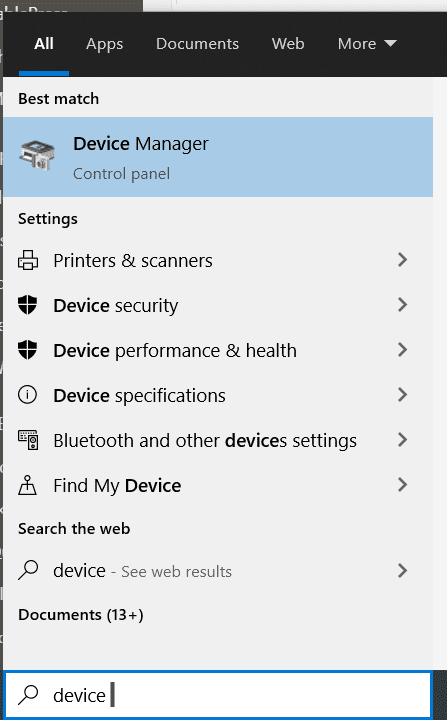
- Type “Device…” in your Windows 10 search box. Click on the Device Manager item.

- Go to <Computer Name> >> Sound, video, and game controllers.
- A yellow warning symbol on your Realtek Audio driver indicates a problem.
- Right-click it and click on Update Driver.


- From the list of device drivers on your computer, select Install High Definition Audio Device.

- Now your device driver name will look like “High Definition Audio Device.”
- Install the Realtek driver from the CD, the manufacturer, or its own site.
- Now repeat steps 1-4.
- But this time, select your Realtek driver.


Your Realtek Audio problem should vanish in Windows 10.
But there is a catch!
Realtek Audio Driver Issues
You cannot install the Realtek driver for all PCs, laptops, and all-in-one desktops. There are different cases—
Case 1: If your motherboard is a typical legacy one like the Gigabyte G41MT-S2P, then you are out of luck. This supports only the VIA audio codec. So even though you install the Realtek audio driver, you will not benefit from it.
Case 2: You have an old Nvidia graphics card like GeForce 210. When you install its drivers, it installs its own Nvidia High Definition Audio drivers, which work only with HDMI devices. No analog speakers will work with it. So even though you install Realtek drivers, they don’t work.
Basic course of Action
To find a solution, first there is a need to recognize the problem. Isn’t it?
But before anything, try to do this just like a good sleep for most diseases. May the situation work out, and your panic seem to fall out. Commonly follow the steps:
- Open the Device Manager from the start menu and type DEVMGMT and hit enter.
- Your device manager window will open, and on scrolling up, you will notice all the audio inputs and outputs, wherein the faulty part can be easily caught.
- At the next step, you will find which audio device particularly needs a check on the driver.
- To find which driver is making fussiness, hit Update Driver, which will then give a good search to the Microsoft Database for the matching requirements.
- If it pops up, “You have the most updated one right now,” but your system does have an old driver, this might fix the same.
- And if it doesn’t, then,
- Uninstall the driver without updating.
- Then, manually bring it on board.
- Option 1: Typically go to the Realtek website and find it, but that doesn’t guarantee the solution. Make sure to download the driver from a reliable source to avoid malware or viruses.
- Option 2: A CD must have come along to install the driver, but chances are it must have already expired.
- Option 3: This is much safer and will prevent you from failing every time, i.e., to use Driver Support, which is automatic software that checks for out-of-date drivers or any missing drivers for each device whatsoever for your desktop computer. It will make all your devices ready and optimized within a few seconds of the click.
So that was the basic course to look into and fix your Realtek driver problems.
But for some serious occasions, let’s dig deeper for some specific error encounters.
Error Code 1: 0x000000FF HD Audio Driver Failure
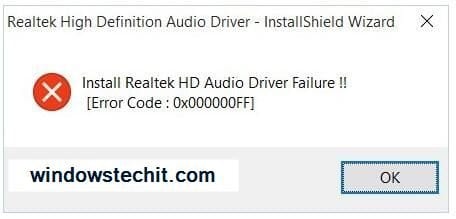
The malfunctioning of the audio driver is a common scene, besides the general MP3 and MP4 disturbances. If you see the above code, don’t panic; the fix is the same as the issue.
- Reinstalling the audio driver in your present operating system version will solve the headache. See, we got you such a quick fix.
- But before acting, checking first ensures it’s a driver problem.
- And second, upgrade your audio driver.
- The steps to which have already been elaborated under the Basic Course of Action.
Error 2: The issue—”No audio output device is installed” error in Windows 10—FIX 2020
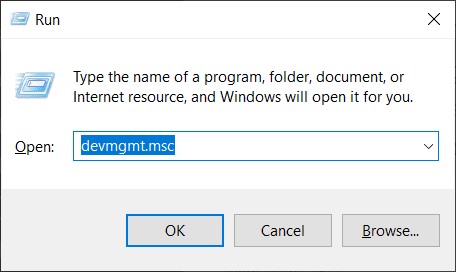
Sometimes, you can see a warning symbol on the sound icon present at the bottom right of your desktop screen.
There will be a window displayed under the name “Playing Audio” that will run a check through to DETECT PROBLEMS and then Scan for Hardware Changes. After a couple of minutes, it might say, “Troubleshooting couldn’t identify the problems.”
The Solution:
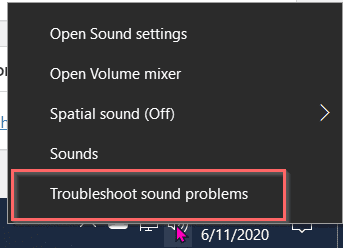
- Open the Run dialogue box by using the key combination Windows + R.
- Type devmgmt.msc over the blank space provided, and you will land onto the Device Manager Window.
- Then click on the Action Tab in the menu bar < Add Legacy Drivers.
- Click on Next, and select the second option on it, Install the hardware that I manually select from a lot (Advanced) and then
- Find and expand Sound, Video, and Game Controllers.
- Find a Realtek device or another device with a yellow triangle and an exclamation mark in the right window that is open.
- Click on the device to select it.
- Let the installation get completed, and after that, reboot your system.
- This procedure will fix the issue.
- Click on the sound button on the home screen again to confirm the same.
Error Code 3: “Realtek HD Audio Install Failure/Corrupt/Incompatible Sound Device ”-
While fixing your sound card, you update it after clearing the old files and replace them with the new ones. It may result in no sound. You end up getting something like the below error.

The Fix
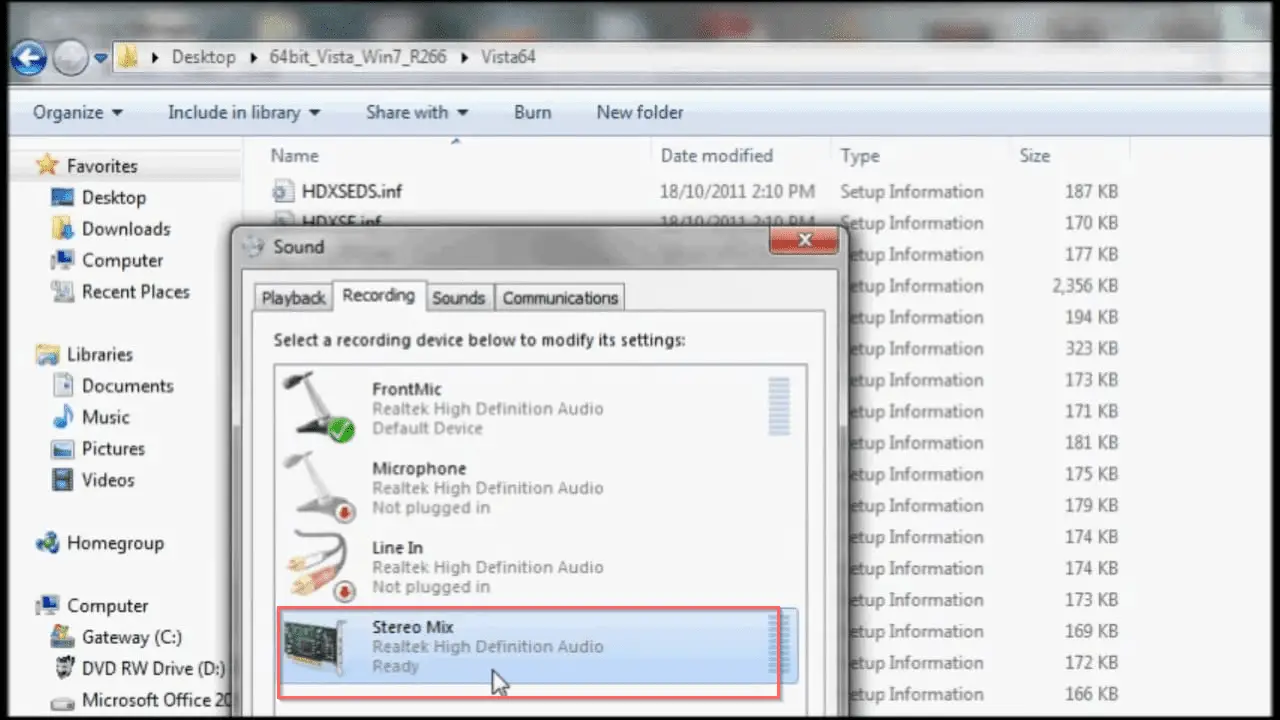
While using the regular Windows HD Audio, you might be refrained from recording direct sounds from audio clips from videos or whatsoever due to the absence of the stereo audio mix option.
- Here you can see that it shows the 64-bit Windows 7 release of the Realtek HD audio codec for your Realtek card.
- As you can see, it’s a compressed zip file with .exe. Use WinRAR and extract its own folder.
- By entering this, you will know that the file is full of audio drivers.
- Go to the Control Panel, and go to Device Manager.
- Scroll down to Sound, Video, and Game Controllers.
- Click on the Realtek High Definition Audio option displayed there.
- Go to Driver > Update Driver.
- Then choose the Browse my computer for Driver Software option.
- It will automatically get directed to the zipped file extracted earlier.
- Windows will use these drivers to update its requisite driver instead of asking you to choose one.
- After that, you can restart your computer.
- Click on the sound icon to confirm the successful addition of the stereo mix to your sound card.
Error Code #4: Speakers or DTS Headphones Not Working on Windows 10
If you are using the latest ASUS gaming laptop, you are more likely to use a headset. It needs audio drivers based upon the model. But if you need a better surround sound experience, you need a good gaming headset.

If this headset uses your Realtek Audio drivers for sound, then sometimes it can give problems, such as audio distortion or connectivity issues, which can affect your overall gaming experience. To rectify this, follow these steps.
- Uninstall DTS Head. phone: X 1.1 on Windows 10.
- Go to Device Manager > Sound, Video, and Game Controllers.
- Right-click the Realtek Audio and update the driver.
- Download the latest DTS driver from the ASUS manufacturer page.
- Then install the DTS Component driver, based on the instructions on the downloads page.

Error Code #5: Audio Problem with Troubleshooter not working
In many cases Intel chipsets also provide audio codecs.
So even though you are using a Realtek sound card or related drivers, it is not its problem.
When your speaker output is giving you problems, you can try the audio troubleshooter in Windows 10.
Sometimes it resolves the problem. On the contrary, it can only be a temporary relief, and the problem returns. Windows Audio Troubleshooter does not suggest the actual reason behind it.
You can try uninstalling the Realtek audio driver and reinstalling it.
But if that doesn’t fix it, then it is a problem with the express chipsets of your motherboard.
For example, you need to reinstall the Intel® High Definition Audio (Intel® HD Audio) codecs or Intel® Display Audio, which can better solve the problem.
If you are using a different motherboard chipset, then install the corresponding audio codecs.
Error Code #6: Realtek Audio driver problem in Windows 10 1903
If you are using headphones and speakers, then you can face dynamic switching of the Realtek Audio driver between the PC speaker and the headphones. This problem is faced in the Windows 10 1903 version.
You can listen to only one sound device at a single time in Windows 10.
But if you need to switch multiple audio devices, then you need to plug in that device. Otherwise, you can change the default playback device.
Sound plays through PC speakers even though you want to listen through headphones.
When you unplug headphones and replug them, the sound still plays through PC speakers only. Either you need to restart the computer or make headphones the default playback device.
In the Windows 10 1903 version, the Realtek audio driver installs a service called “Realtek Audio Universal Service” or “RtkAudUService64.exe.” This can cause the issue regarding dynamic switching between headphones and speakers, leading to audio not being routed correctly when headphones are plugged in or unplugged.
- Kill the process related to it in the Task Manager.
- Disable the startup item called “Realtek HD Audio Universal Service.”
- Disable the related service in the Computer Management tool.
- Open Registry Editor and navigate to the following path. HKEY_LOCAL_MACHINE\SOFTWARE\ Microsoft\Windows\ CurrentVersion\Run
- Then delete the following entry—RtkAudUService.
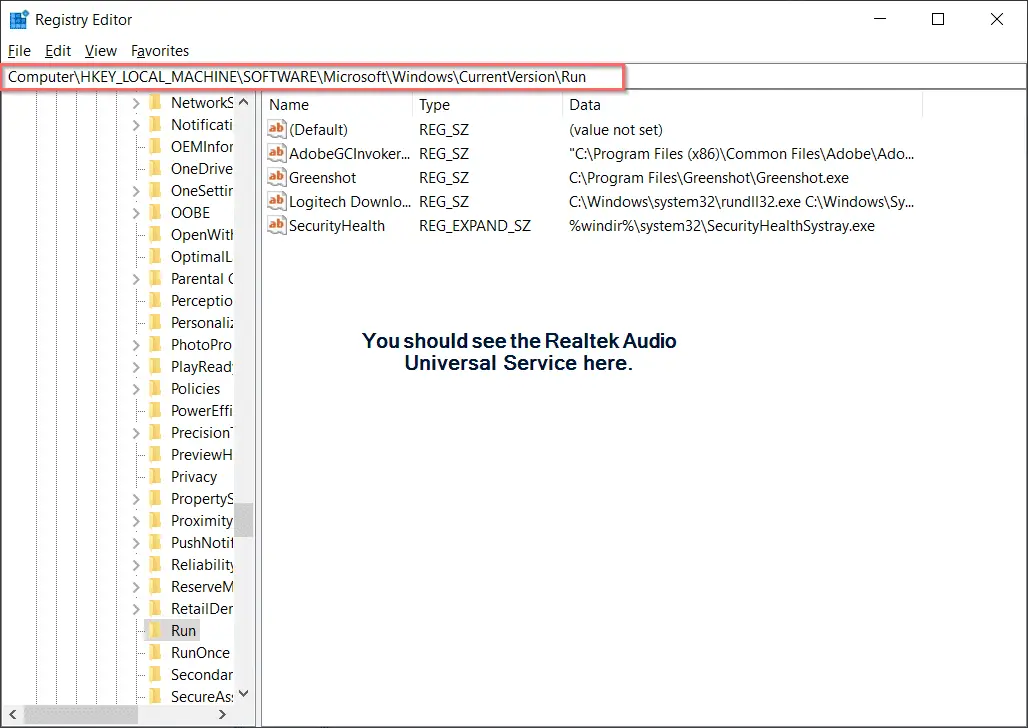
These steps will solve the sound problem when switching between PC speakers and headphones in the Windows 10 1903 version only.
This driver is installed in many Dell and HP laptops.
It might have been fixed in the newer version of Windows 10—like the 1909 or 2004 versions.
This problem does not arise if the startup service is called “Realtek HD Audio Manager.” So check your sound driver service name before you apply this solution.

thank you! the first solution worked for me