
What do Windows 11 gaming benchmarks show compared to Windows 10?
Windows 11 25H2 slightly beats Windows 10 22H2 in most modern games.
Gains range from about 1 percent to over 50 percent, depending on the title and hardware.
Some games, and some competitive shooters, still run better on Windows 10.
Introduction
For years, gamers said Windows 10 was faster than Windows 11.
I dug into the newest 2026 benchmarks. The story is more complicated than that.
After the 24H2 and 25H2 updates, Windows 11 pulls ahead in more titles. But the gap still depends on your game, your GPU, and your CPU. Some older tests, and even some brand-new ones, still show Windows 10 winning.
In this article, I walk through the real benchmark data. I cover the newest 25H2 tests, the original 2024 CPU comparisons, and everything in between.
I show you which games benefit most, how AMD and Intel hardware differ, and why minimum FPS matters as much as your average. I even flag a misleading benchmark claim from Microsoft itself. Every table below names its source and hardware, so you know exactly where each number comes from.
What changed between Windows 11 23H2 and 25H2 for gaming
For a long time, the main difference between Windows 10 and Windows 11 was one setting, not the OS itself. Memory integrity, also called “core isolation,” runs by default in Windows 11. It adds overhead in some games.
The 24H2 update changed things. Testers saw Windows 11 close the gap, then reverse it in several titles. By 25H2, Windows 11 was beating Windows 10 across most tested games.
I want to flag one thing, though. This progress wasn’t a straight line. Some benchmark coverage found that 24H2 itself briefly caused performance drops compared to 23H2, with some games seeing nearly 10 percent. Later patches fixed it. Don’t assume one Windows build stays the same forever.
The current Windows 11 Gaming benchmarks: 25H2 vs Windows 10
TechSpot ran one of the most detailed tests I’ve seen.
They used a Ryzen 9800X3D and an RTX 5090. They tested 14 games at 1080p, 1440p, and 4K. They disabled memory integrity on both systems for a fair fight.
They even cross-checked their most surprising result, Horizon Zero Dawn Remastered, on a second, slower CPU to ensure it held up.
Reference table: TechSpot 2026 test (Ryzen 9800X3D + RTX 5090, Memory Integrity disabled)
| Game | 1080p | 1440p | 4K |
|---|---|---|---|
| Rainbow Six Siege X | +3 to 4% | +3 to 4% | No difference |
| Battlefield 6 | About -1% | About -1% | About -1% |
| Arc Raiders | +11 to 15% | +11 to 15%, up to +22% on 1% lows | +11 to 15% |
| Borderlands 4 | +13% | +13% | +9% |
| Marvel Rivals | +4% | +4% | No difference |
| Spider-Man 2 | +7% | +7% | +5% |
| Horizon Zero Dawn Remastered | +10% | +10% | +8% |
I want to highlight Horizon Zero Dawn Remastered.
TechSpot re-ran it on a Ryzen 7 9700X, a slower chip. The margins held: 9 percent faster at 1080p and 1440p and 7 percent at 4K.
That consistency makes it one of the most trustworthy results in the whole test.
Not every result held up that well. TechSpot’s own testers called The Last of Us Part II Remastered the most confusing result in the suite. They couldn’t explain it cleanly.
Hardware Unboxed ran a separate suite of 14 games.
They found Windows 11 25H2 about 1.2 percent faster at 1080p, growing to around 5 percent at 1440p and 4K.
Their numbers: 194 FPS at 1440p on Windows 11 versus 185 FPS on Windows 10, and 141 FPS versus 134 FPS at 4K. Two testers, two different rigs, same direction. That’s meaningful after years of hearing the opposite.
Older hardware, older data: the 2024 CPU-specific results
Don’t assume Windows 11 always wins.
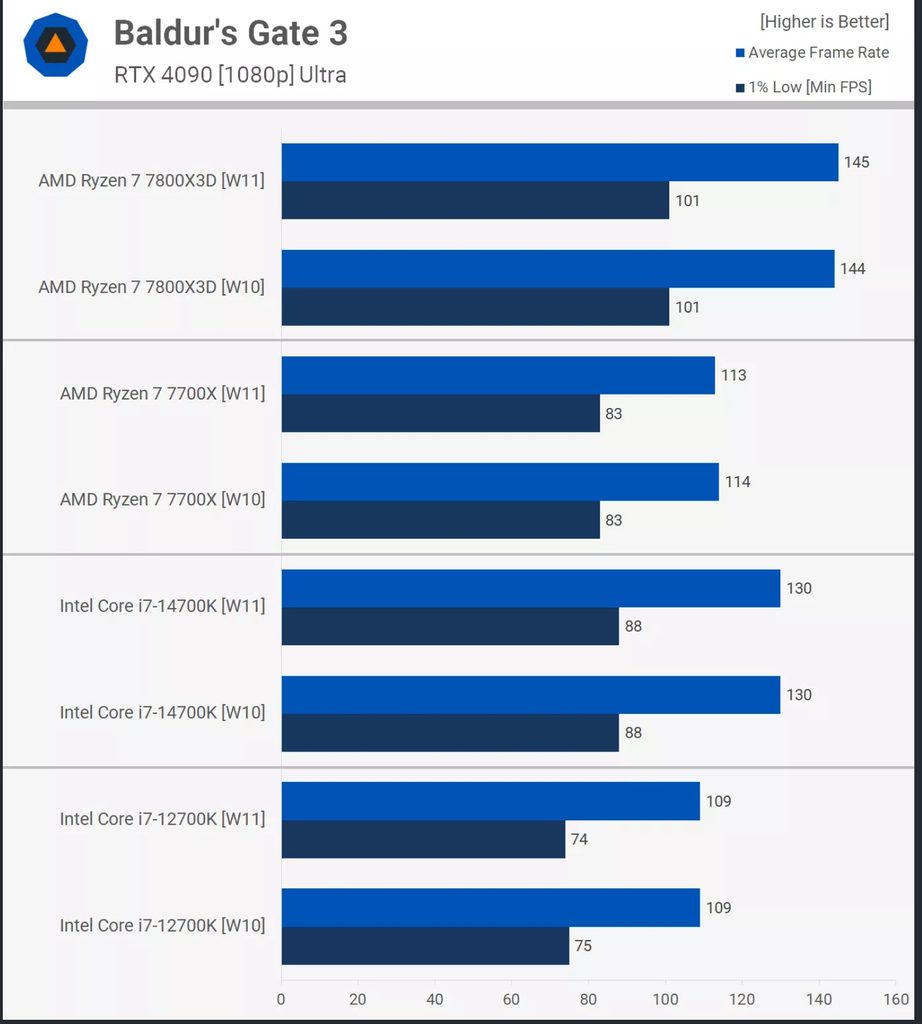
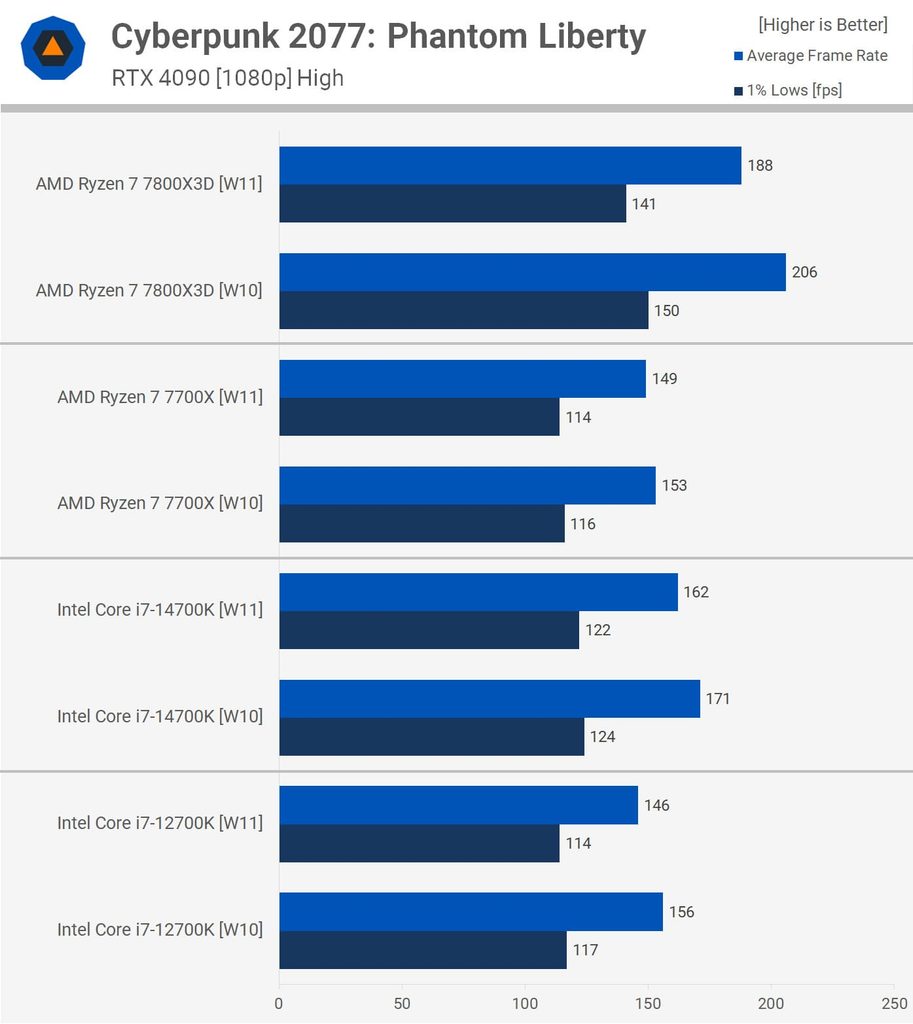
Look at TechSpot’s original 2024 test first. They used a Ryzen 7 7700X, a 7800X3D, an Intel Core i7 12700K, and a 14700K, all paired with an RTX 4090, across 13 games.
This is the test that made those CPU names famous in gaming forums. It found the opposite result in several games.
Reference table: TechSpot 2024 test (7700X, 7800X3D, 12700K, 14700K + RTX 4090)
| Game | Result | Notes |
|---|---|---|
| Counter-Strike 2 | Windows 10 faster: 7700X -10%, 14700K -11% | 7800X3D and 12700K showed smaller but consistent gaps in the same direction |
| Baldur’s Gate 3 | No meaningful difference | Consistent across all four CPUs |
| Horizon Forbidden West | No meaningful difference | Consistent across all four CPUs |
| The Last of Us Part 1 | Windows 10 faster by 1 to 2% | Small but consistent gap across tested hardware |
Here’s my takeaway. No OS wins outright. Windows 11’s gaming performance has genuinely improved over time. A 2024 test doesn’t tell you what happens in 2026.
What a newer flagship CPU shows
A newer set of tests used AMD’s Ryzen 9 9950X3D, one of the best gaming CPUs on the market. The results were mixed. That’s precisely why I don’t trust a single CPU generation to settle this debate.
Reference table: Ryzen 9 9950X3D tests (two separate outlets)
| Game | Windows 10 | Windows 11 | Change | Source |
|---|---|---|---|---|
| Counter-Strike 2 (1080p, low) | 745 FPS | 729 FPS (710 with VBS on) | -2.1%, larger with VBS on | TechRadar / Tech YES City |
| Fortnite (1080p, low) | 591 FPS | 541 FPS | -9.2% | TechRadar / Tech YES City |
| Marvel Rivals, Baldur’s Gate 3, Kingdom Come Deliverance 2 | Not published | Not published | Windows 10 advantage noted, no exact figure | TechRadar / Tech YES City |
| Assassin’s Creed Odyssey | Lower average | +55% average FPS | Large, unexplained gap | Neowin |
| Shadow of the Tomb Raider | Similar | Similar | No meaningful difference | Neowin |
Put these two tests side by side, on the same CPU, and you see my main point clearly. The OS is only one variable. The game engine matters just as much, sometimes more.
Minimum FPS: the metric most reviews skip
Most benchmarks only report average FPS. But an average can hide a game that stutters badly at its worst moments. Windows Central took a different approach in 2025.
They upgraded the same PC from Windows 10 to Windows 11 24H2.
They re-ran seven demanding games with identical settings. They tracked minimums, not just averages. The averages barely moved. The minimums showed a different result.
Reference table: Windows Central 2025 upgrade test (single PC, before and after, minimum FPS)
| Game | Windows 10 minimum FPS | Windows 11 minimum FPS | Change |
|---|---|---|---|
| GTA V Enhanced | 88.9 | 51.6 | -42% |
| DOOM: The Dark Ages | 91.75 | 70.99 | -23% |
| Black Myth: Wukong | 71 | 29 | -59%, cause unexplained by the tester |
I want to be fair to this source. It’s one journalist’s own before-and-after test on a single PC. It’s not a controlled lab benchmark with multiple runs.
So I’d weigh it less than the TechSpot or Hardware Unboxed numbers above. But it tracks something those other tests skip. And the author admitted they couldn’t explain the Black Myth: Wukong drop. I respect that honesty more than a confident guess.
Windows vs alternative operating systems
Two more tests looked past the Windows 10 versus Windows 11 fight entirely. TechPowerUp compared Windows against Linux directly.
They found Windows about 9 percent faster in Arc Raiders, with better 1 percent lows too, and about 5 percent faster in Marvel Rivals.
A newer test came from Valve’s own Steam Machine hardware in July 2026.
YouTuber ETA Prime ran the full benchmark suite, Windows 11 against SteamOS, on that exact device. Windows 11 won every game at higher resolutions, plus a big multi-core lead in Geekbench.
But some margins were razor thin. In Horizon Zero Dawn Remastered, SteamOS hit 58 FPS at 1080p against Windows’s 59 FPS. Basically tied. At 1440p, SteamOS actually pulled ahead, 48 FPS to 47.
Reference table: Windows vs alternative OS tests
| Game | Comparison | Result | Source |
|---|---|---|---|
| Arc Raiders | Windows vs Linux | Windows: +9% average FPS, better 1% lows | TechPowerUp |
| Marvel Rivals | Windows vs Linux | Windows: +5% average FPS | TechPowerUp |
| Horizon Zero Dawn Remastered (1080p) | Windows 11 vs SteamOS, Steam Machine | SteamOS 58 FPS vs Windows 59 FPS, essentially tied | Windows Latest / ETA Prime |
| Horizon Zero Dawn Remastered (1440p) | Windows 11 vs SteamOS, Steam Machine | SteamOS 48 FPS vs Windows 47 FPS, SteamOS ahead | Windows Latest / ETA Prime |
One caveat I want to flag. Valve’s official Windows 11 drivers for the Steam Machine don’t yet support dual boot, as of this test. Treat these results as an early snapshot, not a final verdict.
CPU and platform-specific results
Another test compared Windows 11 25H2, Windows 11 23H2, and Windows 10 directly. They used a Ryzen 7 7800X3D and an RTX 4080 across Fortnite, Call of Duty, and CS2. They applied identical tuning to all three Windows versions, so the OS was the only variable.
Reference table: xilly.net 2026 test (Ryzen 7 7800X3D + RTX 4080, three Windows versions)
| Game | Result |
|---|---|
| Call of Duty | Windows 11 clearly better, regardless of which Windows 11 build was used |
| Counter-Strike 2 | Windows 10 ran about 30 to 40 FPS behind Windows 11 on average |
| Fortnite | High run-to-run variance, differences under 100 FPS treated as margin of error |
I also want to flag Intel’s hybrid CPUs here. If you own a 12th generation chip or newer, you receive performance cores and efficiency cores.
Windows 11 ships Thread Director, a scheduler built for that exact setup. Reported gains run 5 to 15 percent in gaming workloads, depending on the title.
If you’re on an older or non-hybrid CPU, your OS choice matters less than your driver version and background app load.
Are gamers actually adopting Windows 11?
I checked Valve’s Steam Hardware Survey to see what gamers actually run.
As late as mid-2024, Windows 10 held about 50 percent share. Windows 11 sat around 46 percent. That flipped fast. By October 2024, Windows 11 jumped to nearly 52 percent in a single month.
It overtook Windows 10 for the first time. Most people point to Windows 10’s approaching end-of-support date, not a sudden change in performance opinion.
Adoption climbing doesn’t prove Windows 11 is faster. But it does tell you most gaming PCs today already run Windows 11, whatever the benchmark debates say.
Why the results vary so much by game
Even TechSpot’s own team couldn’t explain everything. Arc Raiders and Borderlands 4 showed a big Windows 11 lead. Battlefield 6 and Rainbow Six Siege X showed almost nothing.
Their best guess: each game engine talks to the Windows 11 scheduler and memory path differently. No single benchmark can fully isolate that.
The Assassin’s Creed Odyssey result above is the most extreme example. The unexplained minimum FPS drop in Black Myth: Wukong is another extreme example.
Here’s why this is relevant for you. A 14-game average gives you a general signal. It can still hide the fact that your favorite game behaves nothing like the average.
Be skeptical of the source: how one official benchmark claim got called out
I want to flag something important. Not every Windows 10 versus Windows 11 comparison is reliable. Even Microsoft got called out for its behavior.
Tom’s Hardware found a Microsoft claim of a 2.3 times performance gain for Windows 11, based on Geekbench 6 multi-core scores.
They traced the footnote. The Windows 10 systems ran Intel 6th, 8th, and 10th-generation CPUs. The Windows 11 systems ran 12th- and 13th-generation CPUs. That’s not an OS comparison. That’s old hardware against new hardware, dressed up as an OS win.
Remember this the next time you see a dramatic performance claim, whether it comes from a manufacturer, a YouTuber, or a forum post. Every independent test I cite in this article controls for hardware.
They change only the OS. That’s precisely why I trust their numbers more than vendor marketing.
Step-by-step: getting the gaming performance the benchmarks actually show
Installing Windows 11 alone won’t get you these gains. I applied the same settings the testers used.
Disable Memory Integrity. Go to Settings, then Privacy and Security, then Windows Security, then Device Security, and then Core Isolation. Turn memory integrity off. Restart your PC.
Remove unnecessary background apps. Go to Apps, then Installed Apps, and clear out anything you don’t use.
Disable Xbox Game Bar if you don’t record or use overlays. It runs background processes every session.
Update your GPU drivers straight from Nvidia or AMD. Don’t rely on Windows Update alone. Gaming driver fixes ships faster, direct from the source.
Check DirectStorage support for your games. It cuts load times on compatible NVMe drives.
Enable Auto HDR if your monitor supports HDR and your game lacks native support. This is a Windows 11-only feature. Windows 10 has no equivalent.
Hardware considerations: AMD, Intel, and GPU vendors
AMD had a rough start with Windows 11. One clear example: a new Ryzen 9000 series CPU launched with surprisingly poor performance, traced mostly to Windows 11 itself, not the chip.
The 24H2 update fixed it. Most early problems have now disappeared. But the 9950X3D results above prove game-specific exceptions still happen, even on current hardware.
If you run Nvidia, know these facts. Windows 10 Game Ready driver support for GeForce RTX GPUs runs through October 2026.
Thereafter, updates shift to quarterly security-only releases. If you run AMD Radeon, current drivers still cover both Windows 10 and 11 in most cases. But new gaming features and testing focus now go to Windows 11 first.
Master benchmark reference table
Here’s every data point in this article, grouped by source and hardware. Percentages show the Windows 11 change versus Windows 10, unless I note otherwise.
| Source | Hardware | Game | Result |
|---|---|---|---|
| TechSpot 2026 | Ryzen 9800X3D + RTX 5090 | Rainbow Six Siege X | +3 to 4% at 1080p/1440p, no difference at 4K |
| TechSpot 2026 | Same | Battlefield 6 | About -1%, margin of error |
| TechSpot 2026 | Same | Arc Raiders | +11 to 15%, up to +22% on 1% lows |
| TechSpot 2026 | Same | Borderlands 4 | +13% at 1080p/1440p, +9% at 4K |
| TechSpot 2026 | Same | Marvel Rivals | +4% at 1080p/1440p, no difference at 4K |
| TechSpot 2026 | Same | Spider-Man 2 | +7% at 1080p/1440p, +5% at 4K |
| TechSpot 2026 | Same, cross-checked with Ryzen 7 9700X | Horizon Zero Dawn Remastered | +10% at 1080p/1440p, +8% at 4K (9800X3D); +9%/+9%/+7% (9700X) |
| Hardware Unboxed 2026 | RTX 5090, 14-game suite | Suite average | +1.2% at 1080p, +5% at 1440p and 4K |
| TechSpot 2024 | 7700X, 7800X3D, 12700K, 14700K + RTX 4090 | Counter-Strike 2 | Windows 10 faster, -10 to -11% |
| TechSpot 2024 | Same | Baldur’s Gate 3 | No meaningful difference |
| TechSpot 2024 | Same | Horizon Forbidden West | No meaningful difference |
| TechSpot 2024 | Same | The Last of Us Part 1 | Windows 10 faster by 1 to 2% |
| TechRadar / Tech YES City | Ryzen 9 9950X3D | Counter-Strike 2 | Windows 10 faster by 2.1% |
| TechRadar / Tech YES City | Ryzen 9 9950X3D | Fortnite | Windows 10 faster by 9.2% |
| Neowin | Ryzen 9 9950X3D | Assassin’s Creed Odyssey | Windows 11 faster by 55% |
| Neowin | Ryzen 9 9950X3D | Shadow of the Tomb Raider | No meaningful difference |
| Windows Central | Single PC, before/after upgrade | GTA V Enhanced minimum FPS | -42% |
| Windows Central | Single PC, before/after upgrade | DOOM The Dark Ages minimum FPS | -23% |
| Windows Central | Single PC, before/after upgrade | Black Myth Wukong minimum FPS | -59%, unexplained |
| TechPowerUp | Not specified | Arc Raiders vs. Windows vs Linux | Windows: +9% |
| TechPowerUp | Not specified | Marvel Rivals: Windows vs Linux | Windows: +5% |
| Windows Latest / ETA Prime | Steam Machine hardware | Horizon Zero Dawn Remastered: Windows 11 vs SteamOS | Tied at 1080p, SteamOS ahead at 1440p |
| xilly.net 2026 | Ryzen 7 7800X3D + RTX 4080 | Call of Duty | Windows 11 clearly better |
| xilly.net 2026 | Ryzen 7 7800X3D + RTX 4080 | Counter-Strike 2 | Windows 10 faster by 30 to 40 FPS |
Look at the spread here. That’s the real finding, not a flaw in the data. Test year, CPU generation, whether memory integrity was on or off, and even the game engine itself all change the outcome.
Sometimes the result flips entirely between two tests on the same CPU. Treat each row as one data point about one setup. Don’t treat it as a universal verdict.
Statistics: what the confirmed test data shows
TechSpot’s newer 14-game suite gave Windows 11 a meaningful edge in six titles. Several showed no real difference. None gave Windows 10 a wide lead.
That’s a full reversal from the 2024 CPU-specific testing. Hardware Unboxed’s separate test clocked Windows 11 25H2 at 194 FPS at 1440p versus 185 FPS on Windows 10, and 141 versus 134 FPS at 4K.
Thread Director on Intel 12th generation and newer hybrid CPUs delivers a documented 5 to 15 percent gaming boost over Windows 10. On adoption, Steam’s own survey shows Windows 11 climbing from about 46 percent to over 51 percent share among gamers in just a few months in late 2024.
Best practices for benchmarking your own setup
Disable Memory Integrity on both operating systems before you compare them. Use a fresh install, not an in-place upgrade, whenever you can. If you do test an upgrade, like Windows Central did, remember it’s a different kind of test than a clean install.
Run each test at least three times, then average the results. Test at the resolution you actually play at. The Windows 11 lead tends to shrink at 4K once your GPU becomes the bottleneck.
Match your hardware exactly across comparisons. Never compare across CPU generations, the way Microsoft’s own claim did. Track minimum FPS alongside your average. A game can look fine on paper and still feel rough at its worst moments.
Common mistakes to avoid
- Don’t compare benchmarks from different outlets or years without checking the hardware and Windows build first.
- Don’t assume one game’s result applies to every game you play. The data above shows huge variation by title.
- Don’t leave background recording or overlay software running during a test.
- Don’t trust a dramatic performance claim without checking what hardware was actually compared.
- Don’t look only at average FPS. Ignoring minimums can hide a real stutter problem.
Recommended tools
I use MSI Afterburner, or a similar overlay tool, to track real-time FPS and 1 percent low.
I trust the built-in benchmark modes in games like Call of Duty and Horizon Forbidden West more than manual gameplay testing. I check the Windows Task Manager for background load before each test. I check the Steam Hardware Survey, published monthly by Valve, for free, current OS adoption data.
Practical example
A home user running a Ryzen 7 7800X3D with an RTX 4080 asked me if Windows 11 was worth it for competitive shooters.
Based on the CS2 and Call of Duty data above, my answer was yes for Call of Duty. Windows 11 ran clearly better there, no matter the build. CS2 showed a different result.
The gap was big enough that staying on Windows 10 actively cost frame rates on that system. A second user on a Ryzen 9950X3D, asking about Fortnite, would get the opposite answer from me, based on the data from Tech YES City above.
That’s precisely why I check your specific CPU and game against current data, instead of giving you one general rule.
Frequently asked questions
Is Windows 11 actually faster than Windows 10 for gaming in 2026?
Based on the newest benchmarks, Windows 11 25H2 runs equal to or slightly faster than Windows 10 in most tested games. But older 2024 data, and some newer CPU-specific tests, still show real cases where Windows 10 wins. Competitive shooters like Counter-Strike 2 and Fortnite are the clearest examples.
Does memory integrity really affect gaming performance?
Yes. Memory integrity, also called “core isolation,” runs by default in Windows 11. It adds real overhead in some games, including several of the CS2 and Fortnite results above. Testers always disable it before running a fair comparison.
Do I need a specific CPU to see Windows 11 gaming benefits?
No. But if you own an Intel 12th generation chip or newer, you get an extra boost from Thread Director. Windows 10 doesn’t have this feature.
Should I upgrade to Windows 11 just for gaming performance?
If your hardware supports it, yes. Current data backs the upgrade. Windows 11 now matches or beats Windows 10 in the most recent tests, and it’s the only OS still getting full support since Windows 10 hit end of support in October 2025. Steam’s own survey shows most gamers already switched.
Is AMD or Intel hardware better optimized for Windows 11 gaming?
Both run well on current Windows 11 builds. AMD’s early launch issues, and its brief Ryzen 9000 series stumble, are mostly fixed now. Intel’s hybrid CPUs get an extra scheduling boost. But the 9950X3D results above prove individual games can still favor either OS, regardless of who made your CPU.
Conclusion
The 2026 benchmarks tell a more nuanced story than the headlines suggest. Windows 11 25H2 holds a small, real, repeatable edge over Windows 10 22H2 in most recently tested games.
I even found a result that held up across two different CPUs: Horizon Zero Dawn Remastered.
But older 2024 data, newer 9950X3D tests, and minimum FPS data from a simple upgrade test all agree on one thing. Certain game engines and competitive shooters can still favor Windows 10, sometimes by a real margin.
If you’re still on Windows 10, I’d upgrade. Performance is generally matched or better, and only Windows 11 gets full support now. Most gamers, according to Steam’s own numbers, already made the switch.
My advice: disable Memory Integrity, keep your GPU drivers current, check your specific games against real data, watch your minimum FPS and not just your average, and stay skeptical of any big performance claim, even the ones that come from Microsoft itself.
Primary benchmark sources
- TechSpot — “Which is Faster for Gaming, Windows 10 or Windows 11?” (2024 test, 7700X/7800X3D/12700K/14700K + RTX 4090) https://www.techspot.com/article/2872-which-is-faster-windows-10-or-windows-11/
- Notebookcheck — Hardware Unboxed 25H2 coverage (14-game suite average, 1440p/4K FPS numbers) https://www.notebookcheck.net/Windows-11-is-now-reportedly-faster-than-Windows-10-in-gaming-after-latest-25H2-update.1212476.0.html
- TechRadar—”AMD’s most powerful processor ever actually runs better on Windows 10″ (Tech YES City’s Ryzen 9950X3D test, CS2/Fortnite) https://www.techradar.com/computing/cpu/amds-most-powerful-processor-ever-actually-runs-better-on-windows-10-than-windows-11
- Neowin—”Windows 10 vs Windows 11 2025 performance benchmarks” (9950X3D, Assassin’s Creed Odyssey/Shadow of the Tomb Raider) https://www.neowin.net/news/windows-10-vs-windows-11-2025-performance-benchmarks-shows-holdouts-they-should-upgrade/
- Windows Central — “Windows 11 vs. Windows 10 for gaming: Is it worth upgrading?” (minimum FPS upgrade test) https://www.windowscentral.com/gaming/pc-gaming/windows-10-vs-windows-11-pc-gaming-performance-test
- TechPowerUp—”Windows 11 vs Linux Gaming Test Reveals There’s More to It Than FPS” https://www.techpowerup.com/350791/windows-11-vs-linux-gaming-test-reveals-theres-more-to-it-than-fps
- Windows Latest — “Windows 11 wins the Steam Machine benchmarks but loses the experience” (ETA Prime’s SteamOS comparison, July 2026) https://www.windowslatest.com/2026/07/16/windows-11-wins-the-steam-machine-benchmarks-but-loses-the-experience-and-you-shouldnt-install-it/
- xilly.net—”Windows 11 25H2 vs 23H2 vs Windows 10 Gaming Benchmarks 2026″ (Ryzen 7 7800X3D + RTX 4080, three-way comparison) https://www.xilly.net/blog/windows-11-25h2-vs-23h2-vs-windows-10-gaming-2026
Supporting/context sources
- Tom’s Hardware — “Microsoft’s sketchy Win 10 vs Win 11 performance claims” (the misleading 2.3x marketing claim callout) https://www.tomshardware.com/software/windows/microsofts-sketchy-win-10-vs-win-11-performance-claims-pit-a-9-year-old-pc-against-a-modern-machine-to-claim-2-3x-gain
- TechRadar — “Windows 11 is finally more popular than Windows 10” (Steam Hardware Survey, August 2024 crossover) https://www.techradar.com/computing/windows/windows-11-is-finally-more-popular-than-windows-10-at-least-in-the-world-of-pc-gaming
- Yahoo/Digital Trends—”Gamers are finally flocking to Windows 11″ (Steam Hardware Survey, October 2024 jump to ~52%) https://tech.yahoo.com/computing/articles/gamers-finally-flocking-windows-11-151340583.html
- VCOM—”Windows 11 25H2 vs Windows 10 22H2 for Gaming” (source for the 24H2-caused-regression claim, noted as “reported by” since it cites unnamed benchmark coverage rather than being the primary source itself) https://www.vcom.hk/blogs/news/windows-11-25h2-vs-windows-10-22h2-for-gaming-is-windows-11-finally-faster-in-2026
